Buena Park Wood Flooring takes on wood-flooring in Cerritos with more than 20 years in the trade, and many of the conversations we have here start with one question before any sample board comes out: whose floor is this, and for how long? That answer shapes the material, the finish and the budget more than any catalog does, so we settle it before measuring a single room.
Every estimate we write is itemized line by line, so an owner can see what the subfloor work, the boards, the finish and the trim each cost instead of one square-foot figure. Moisture is measured in the wood, and in any concrete underneath, before material is ordered, and those readings go on paper with the estimate.
When someone lives in the home through the work, we hand over a written cure schedule showing when each room can take foot traffic and when furniture can go back. For an owner in a one-bedroom unit with nowhere else to sit, that sheet matters nearly as much as the floor itself.
Cerritos’s City-Monitored Senior Condos and Their Resale Rules
Cerritos has three for-sale senior condominium communities whose resale the City of Cerritos monitors: Emerald Villas with 126 units, Pioneer Villas with 98 and Fountain Walk with 18, for 242 homes in all. They were developed in 2000, 2001 and 2007, and the City’s affordable senior housing listing reports every unit in all three communities as sold.
Emerald Villas sits at the intersection of Carmenita Road and Houston Avenue, Pioneer Villas at the southeast corner of Pioneer Boulevard and Eberle Street, and Fountain Walk at the southeast corner of 183rd Street and Carmenita Road. The City oversees monitoring and affordability compliance for all three, and that oversight is what sets these homes apart from the rest of the local market.
Who Can Own and Live in These Units
Under the City’s resale procedures, every unit must be owner-occupied, and renting one out is prohibited. A buyer has to be at least 62 years old and fall within the City’s income limits; for 2026 the low- and moderate-income limit for a one-person household is $93,300. Transfers to family members are not allowed unless they meet the same age and income requirements.
That combination shapes how we approach a floor in these buildings. The person choosing the flooring is almost always the person who will walk on it every day, and there is no tenant turnover to plan around. The job is about one owner’s comfort and daily routine, not a rental refresh or a quick sale.
How the Resale Price Is Capped
The City sets the maximum resale price as the lesser of two figures: the purchase price the seller originally paid, increased by the percentage change in the Consumer Price Index, or the amount set under Health and Safety Code Section 50053(b). That maximum includes any additional fees, charges, commissions or other consideration.
A resale moves through an eight-step City process, from the seller’s notice to a final approval letter and close, and refinancing also needs City approval. We do not give pricing advice; the City sets the number. We mention the rules only because they change how an owner should weigh a flooring budget.
Where Upgrades Stand
The resale procedures state plainly that improvements and upgrades are not separately credited. A new wood floor, a better finish or fresh trim does not move the capped price. Whatever an owner spends on flooring here is spent on their own years in the unit, and we build every recommendation on that basis rather than talking about payback.
Looking for wood-flooring closer to Stanton? See Wood-Flooring Services in Stanton.
Choosing Floors for Your Own Years in the Unit
With the resale question set aside, the decision gets simpler and more personal. The right floor is the one that suits how you live now and how you expect to live over the coming years: how you move through the rooms, what sits on the floor, how much upkeep you want and how the surface feels underfoot.
Comfort, Footing and Surface
Sheen level matters more than most owners expect. A high-gloss finish shows every scuff and can look slick under bright light, while a satin or matte sheen hides wear and reads calmer in a small room. We bring finished samples and look at them under the unit’s own lighting before anyone commits.
Species and hardness come next. The Janka hardness rating gives a rough comparison of dent resistance, and white oak and hickory rank above many softer choices, holding up better under chair legs and dropped pans. A wire-brushed or lightly textured surface also hides small marks that a smooth, glossy board would put on display.
Color deserves a slow decision too. Red oak can drift toward orange as a finish ambers, and a stain pushed too far toward gray can look flat in a room with little daylight. We lay down test patches on real boards, because a color that looks right on a store sample often looks different across a whole living room.
Engineered or Solid, Glued or Floating
In condominium rooms, engineered flooring is often the practical choice. Its layered core resists seasonal movement better than solid strip, and the wear layer thickness tells you how many times it can be sanded later on. For an owner who plans to stay, a thicker wear layer leaves room for a future refinish instead of a replacement.
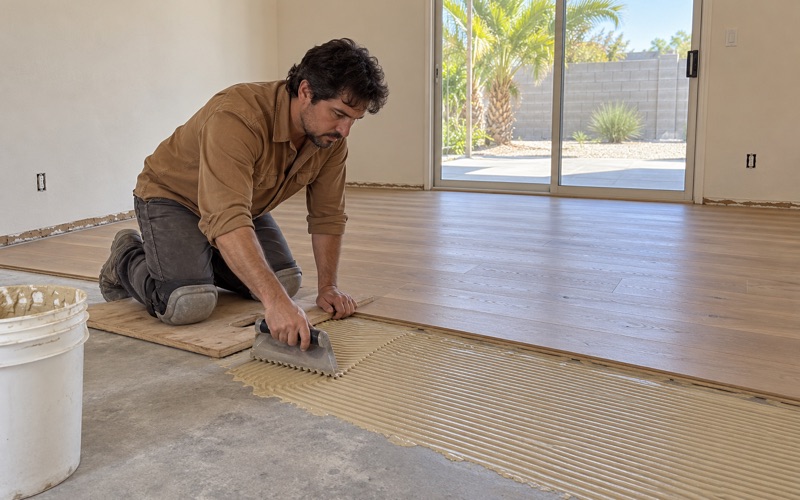
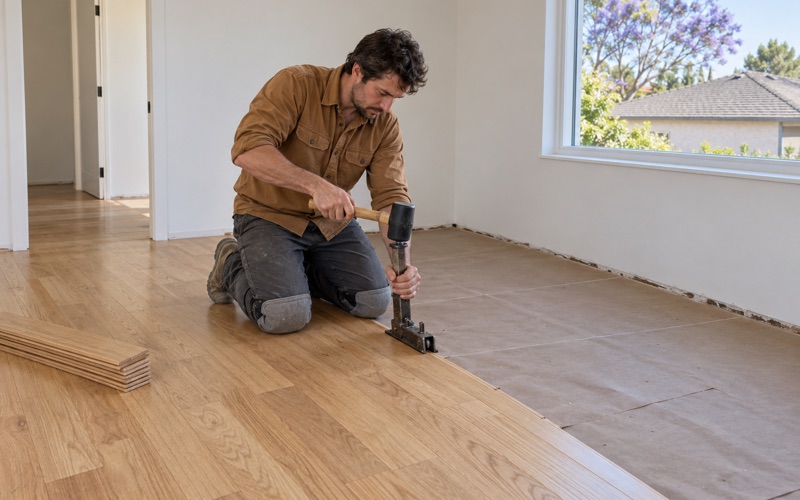
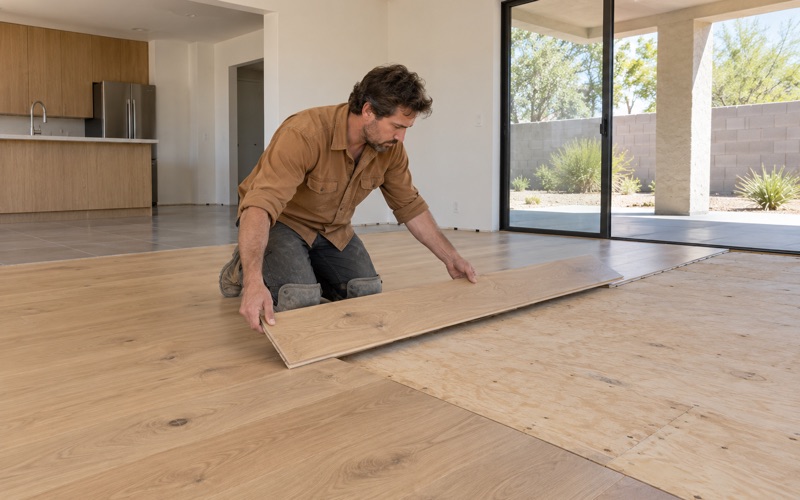
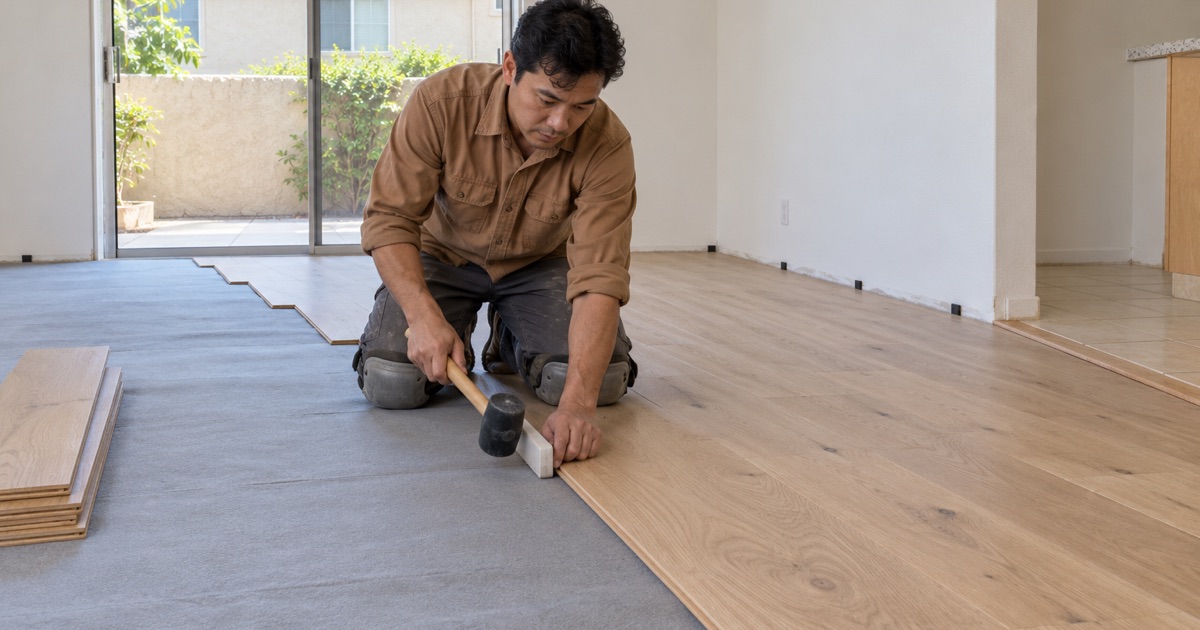
Installation method depends on what is underneath. A glue-down installation feels solid and quiet underfoot, while a floating installation over acoustic underlayment can go down faster. We check the subfloor, measure moisture, and follow NWFA installation guidelines on acclimation and expansion gaps before recommending either one.
Finishes Suited to Living in Place
Finishes we apply in Cerritos come from products legal under SCAQMD Rule 1113, which sets the 275 g/L VOC limit for wood coatings in the South Coast air basin. A waterborne polyurethane dries faster and with less odor than an oil-modified one, which counts when the owner sleeps two rooms away from the work.
A hardwax oil finish suits owners who would rather touch up a worn patch than recoat a whole room. Prefinished boards skip site finishing altogether, which shortens the stretch of days the unit is out of use. We set out the trade-offs in writing, so the choice stays with the owner.
Planning Floor Work in a Small Condo
These units are compact. Emerald Villas homes run from 700 to 1,200 square feet, Pioneer Villas from 750 to 1,000 and Fountain Walk from 750 to 900. In a space that size, moving furniture, sequencing rooms and keeping one clear path through the home take as much planning as the flooring itself.
Sequencing Rooms Around the Owner
We usually work in phases so the bedroom or the living room stays usable while the other side is done. Furniture shifts within the unit where it can, and the written cure schedule tells the owner which night they can sleep in their own room again and when heavier pieces can come back.
Cerritos limits construction work to Monday through Friday, 7:00 a.m. to 6:00 p.m., and Saturday, 10:00 a.m. to 5:00 p.m., with no work on Sundays or holidays. We schedule loud steps such as cutting and sanding inside those hours, which also keeps the job considerate of neighbors who share walls and floors.
Wet Areas and Transitions
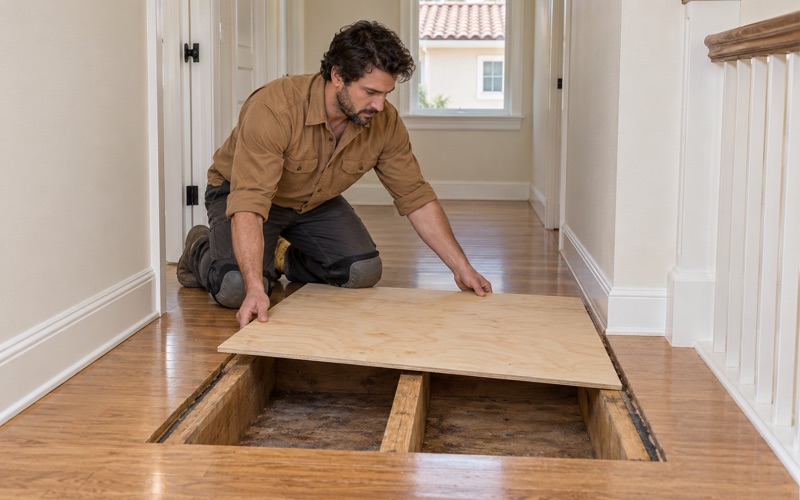
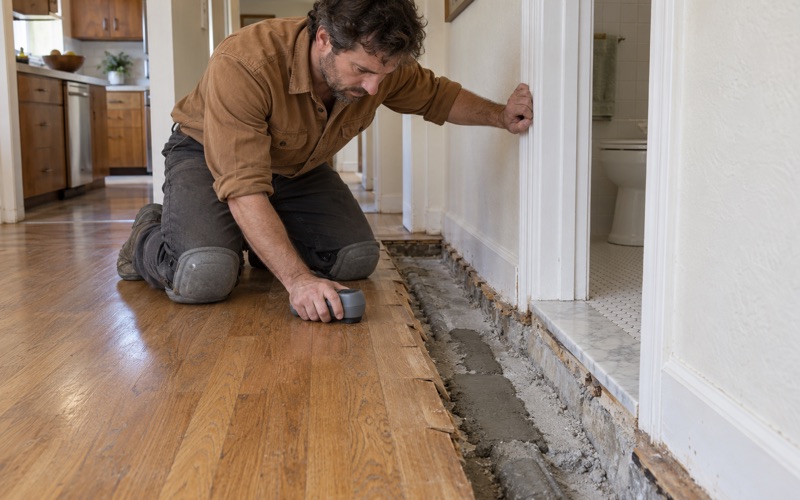
Kitchens and baths are where hidden trouble tends to surface. Soft spots near a toilet, tub or entry door are traced to the subfloor before we price a finish floor over them, because a new board laid over a damaged base only hides the problem for a while.
Transitions get their own line on the estimate. Where wood meets tile or carpet, a reducer strip or T-molding keeps the edge low and even, and shoe molding covers the expansion gap along the base. For an owner who walks the same path many times a day, a smooth threshold is part of the floor, not an afterthought.
Dust and Air in a Shared Building
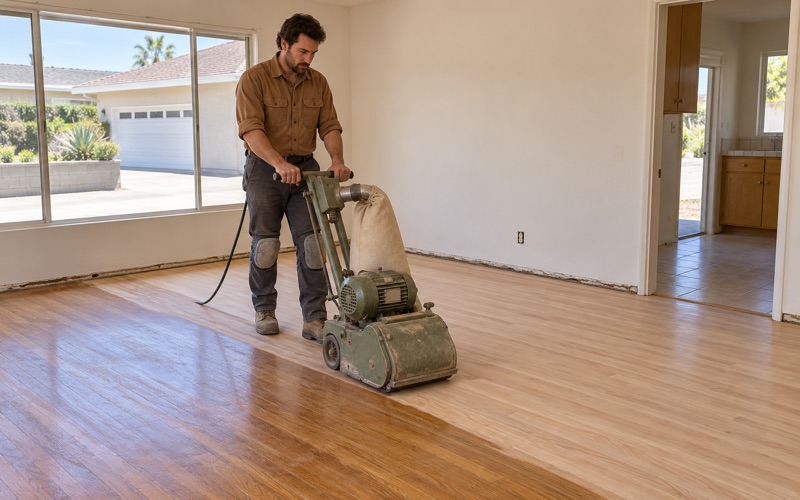
Where site finishing is needed, a dustless sanding system paired with a drum sander, edger and orbital sander keeps fine dust out of shared hallways and vents. We close off the work area, vacuum between coats, and note the grit sequence and coat count on the written record alongside the moisture readings.
Houses Across the Rest of Cerritos
The senior condos are a small slice of the city. Cerritos covers 8.86 square miles, and most of its housing is detached; of 16,343 housing units, 13,147 are one-unit detached. According to the 2024 five-year ACS, 55.1 percent of those units were built in the 1970s, making that decade the center of the city’s housing stock.
What Houses of That Era Tend to Need
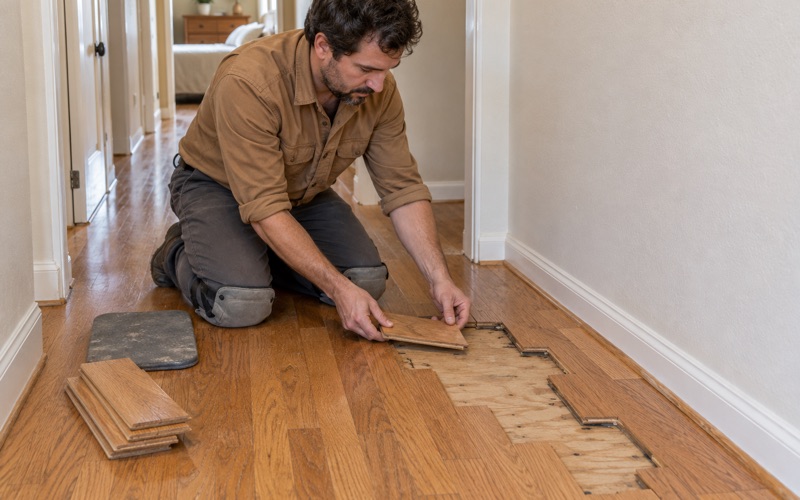
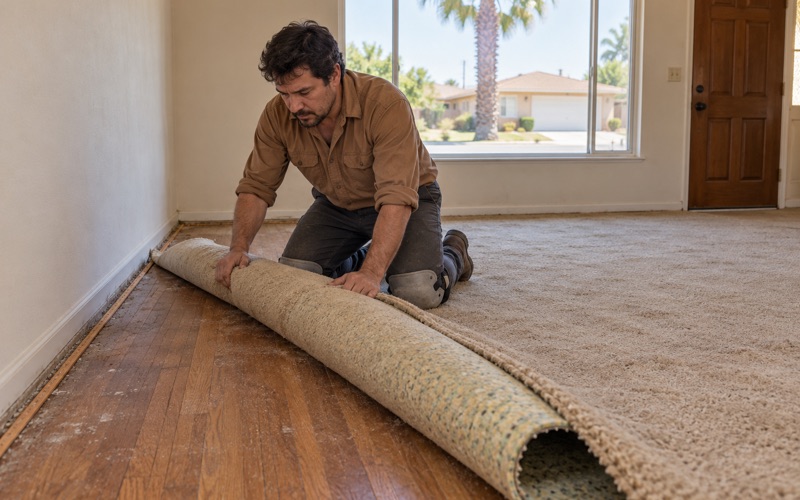
In houses of that age, whatever sits under old carpet has to be checked rather than assumed, and carpet tack strip and staples come out before anything new goes down. Where existing wood turns up, we assess it board by board before quoting a replacement, since a weave-in repair or a refinish often makes more sense.
Houses built before 1978 get lead-safe work practices under the EPA Renovation, Repair and Painting rule. Old parquet or tile set in black mastic is treated as a possible asbestos question first, and an asbestos survey comes before any adhesive removal begins.
Stairs, Water Damage and Paperwork
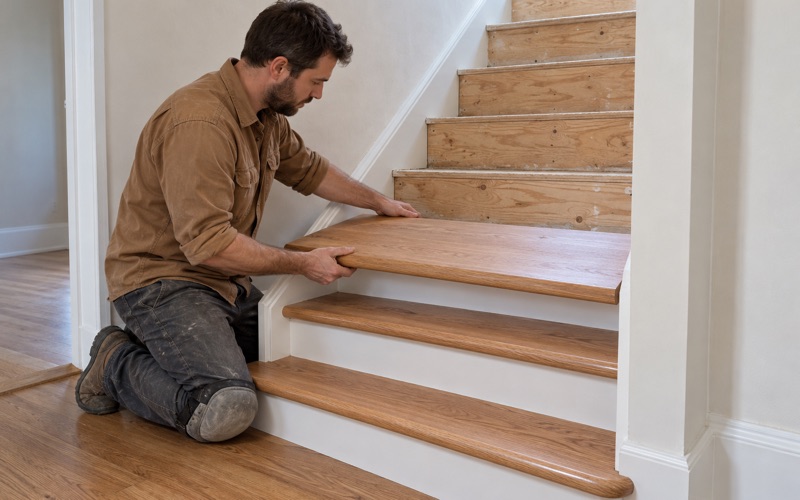
Stairs are priced per tread and riser rather than folded into a square-foot number, so an owner can see exactly what the staircase costs. After water damage, we rebuild once the area has dried and keep photos and moisture readings an insurance adjuster can use. After a slab leak, the floor waits until the plumber has repaired or rerouted the line.
Whether the home is a 750-square-foot condo near Carmenita Road or a detached house from the 1970s, the approach stays the same: measure first, write it down, and let the owner decide with the full picture in front of them.
- 20+ Years in Wood Flooring
- Itemized Written Estimates
- Lead-Safe Sanding