Buena Park Wood Flooring brings more than 20 years of wood-flooring work to Cypress, and a good share of it happens in the gap between one tenant moving out and the next moving in. A landlord with a short vacancy needs to know which rooms can be saved with a repair, which need a full sand and finish, and which floors have simply run out of life.
This page is written for that decision. We cover what the city itself tells landlords and tenants, who rents here and what kind of home they rent, and how we sort turnover floor work into repair, refinish or replace. Every estimate we hand over is written and itemized, so an owner, a property manager or an incoming tenant can read the same numbers.
Owners who live in their own homes will find the practical sections useful too, since the same moisture readings, finish rules and cure schedules apply to any floor. The lens here is the rental, though, because that is where timing, paperwork and durability pull hardest against each other.
What Cypress Tells Landlords and Tenants
The City of Cypress Housing Division publishes an information page for landlords and tenants. Its starting point is plain: numerous state and federal laws regulate rental housing and the rights and responsibilities of both sides. The page offers general information and guidelines rather than a local rulebook, and Cypress has no local rent ordinance of its own.
The Statewide Tenant Protection Act
The law the city points both sides toward is California’s Tenant Protection Act, Civil Code section 1947.12. It took effect January 1, 2020 and runs until January 1, 2030. Under it, a landlord needs just cause to end a tenancy once the qualifying tenancy period has passed, and annual rent increases are limited to 5 percent plus local CPI or 10 percent, whichever is lower.
We are flooring contractors, not lawyers, and we do not interpret the Act for anyone. What it changes for our work is the calendar. When tenancies run longer, a floor can go years between turnovers, and the vacancy becomes the one practical chance to deal with worn finish, loose boards or a damaged threshold before the next lease starts.
Rental Assistance Since 2020
The same city page notes that since January 1, 2020, landlords cannot reject tenants for participating in rental assistance programs and must accept Section 8, VASH and other assistance. For an owner planning turnover work, the next household can come from a wider pool, and the unit needs to be ready on the schedule the leasing process sets.
A written cure schedule helps here. We tell the owner in writing when each room can take foot traffic and when furniture can go back, so a move-in date is set against real drying times rather than a guess.
What the City Handles, and What It Does Not
Cypress Code Enforcement investigates complaints about property maintenance, abandoned properties and other code violations, and works with owners and tenants to correct them, with administrative citations as its tool. That is a general maintenance channel, not a flooring standard. For deposits and floor wear at move-out, Civil Code 1950.5 is the statute to read, and that question belongs with someone qualified to answer it.
Looking for wood-flooring closer to Cerritos? See Wood-Flooring in Cerritos.
Who Rents in Cypress and What They Rent
Cypress, in northwestern Orange County, counted 50,151 residents at the 2020 census. Of its 16,272 occupied homes, 11,089 are owner-occupied, or 68.1 percent. The other 5,183 households rent, which is 31.9 percent of occupied units. That renter base is large enough that turnover floor work is a steady part of the local picture rather than an occasional job.
Detached Houses and Townhomes
Of those 5,183 renter households, 1,422 rent a detached house and 855 rent a one-unit attached home such as a townhome. Those are the rentals this page mostly has in mind: a whole house or a townhome with its own floors, turned over one unit at a time.
A detached rental tends to carry every kind of wear at once. A kitchen doorway is worn through the finish, a hallway shows pet scratches, and a back bedroom barely looks used. Pricing each room on its own condition, rather than as one blended square-foot figure, keeps an owner from refinishing a room that only needed a screen and recoat.
Larger Buildings
At the other end, 1,055 renter households live in buildings of fifty or more units. Floor decisions there usually run through property management, and the work looks different: glue-down or floating engineered floors, acoustic underlayment and building access rules. We quote that work too, but most of what follows is aimed at the house and townhome owner.
Homes From the 1960s and 1970s
The age of the housing matters more than anything else about a Cypress rental floor. Of 16,920 housing units, 6,574 were built in the 1960s and 4,856 in the 1970s, so 67.6 percent of the city’s housing dates from those two decades. The city incorporated in 1956 as Dairy City, and the dairies gradually sold out to housing developers during the 1960s.
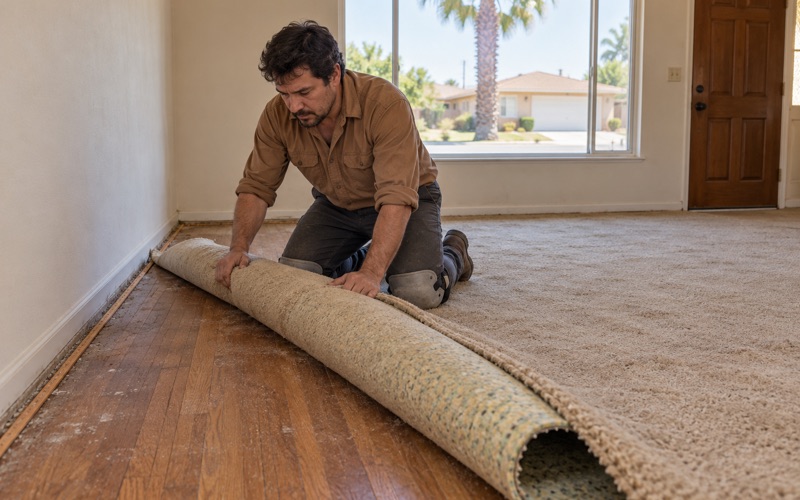
That puts a typical rental at fifty or sixty years old, through many tenants and likely more than one flooring change. We do not assume what sits under the carpet or vinyl in any given house. We lift a corner, look, and assess what is there board by board before recommending anything.
Repair, Refinish or Replace Between Tenants
Most turnover floor work falls into one of three categories, and the right call depends on the floor, the length of the vacancy and how long the owner plans to keep the unit. We walk each room and write the recommendation room by room.
Repair
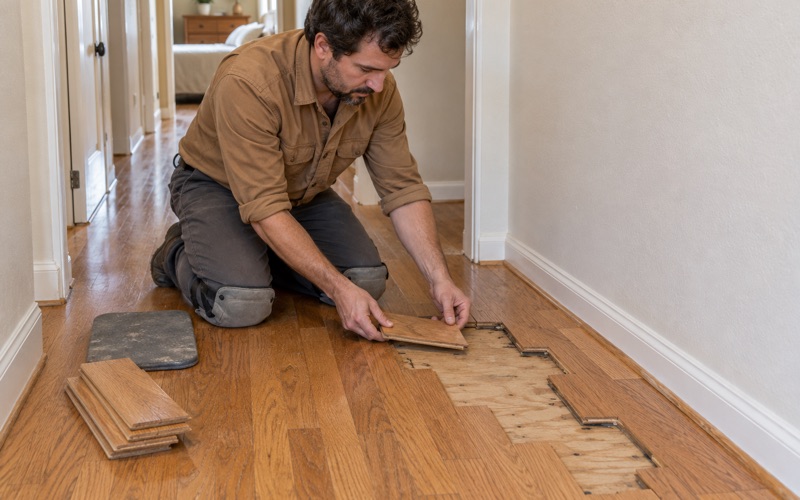
A repair fixes a defined problem without touching the rest of the floor. Common turnover repairs include replacing boards gouged by furniture, a weave-in repair where a wall or cabinet was moved, quieting squeaks, and resetting a loose reducer strip or T-molding at a doorway. Pet urine stains that have gone dark in the wood usually call for board replacement rather than sanding.
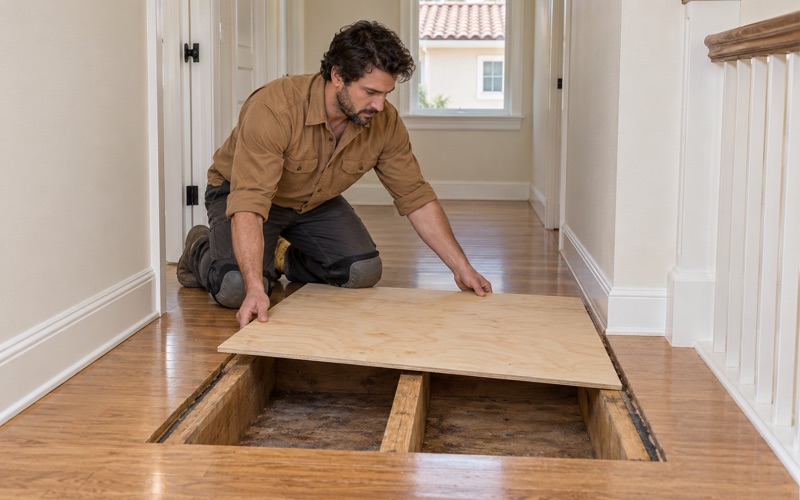
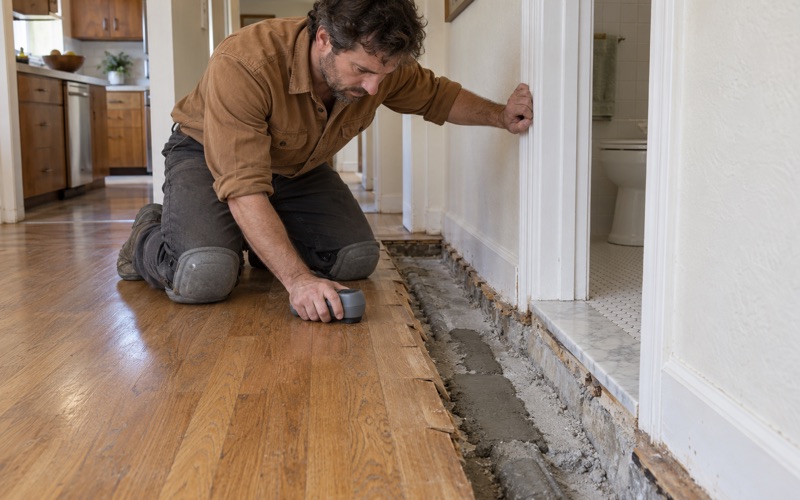
Soft spots near toilets, tubs and exterior doors get traced to the subfloor before we price any finish work. A soft floor at a rental bathroom doorway often points to an old leak, and covering it with new boards only pushes the problem into the next tenancy.
Refinish
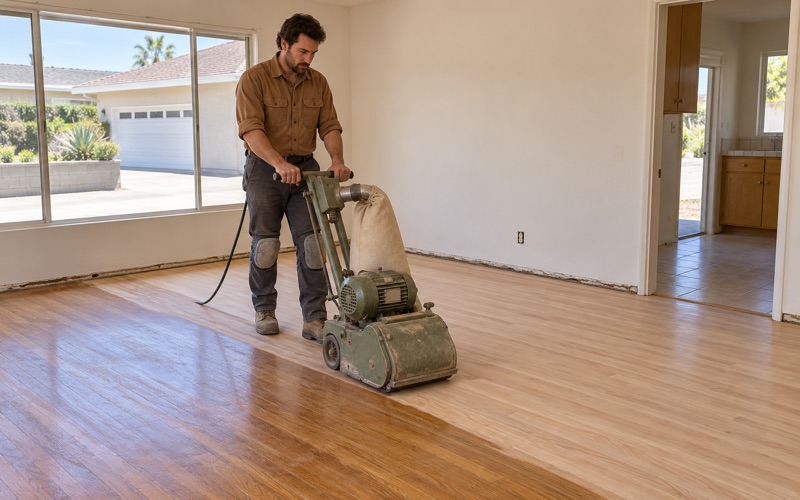
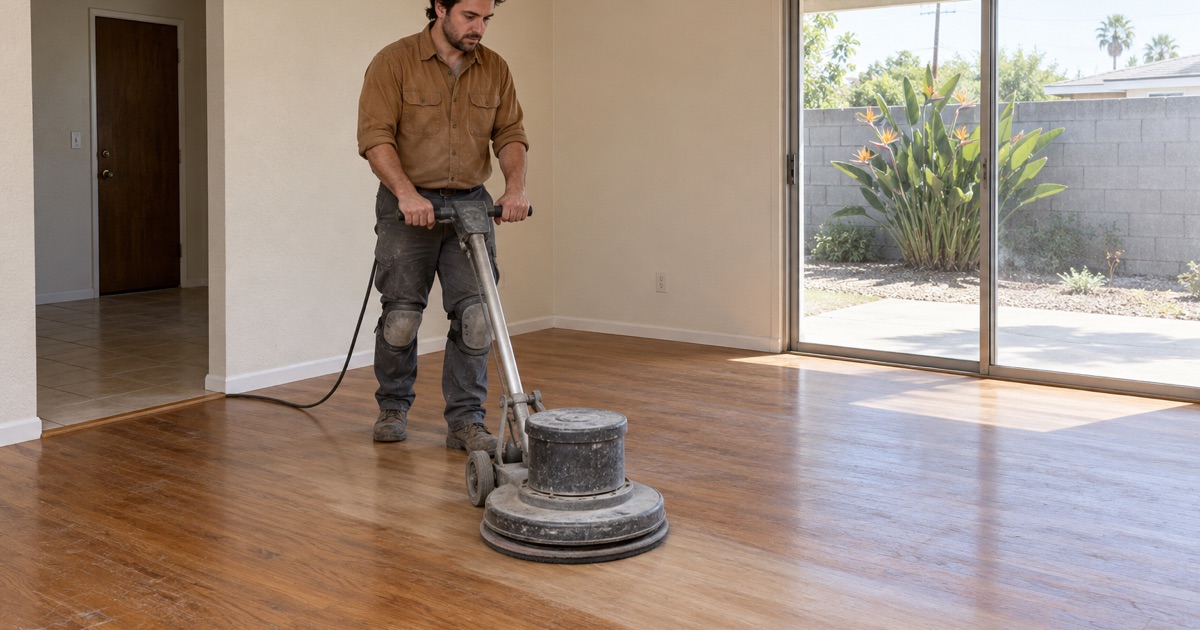
A refinish takes a solid wood floor, or an engineered floor with enough wear layer thickness, back to bare wood with a drum sander, orbital sander and edger, then builds a new finish. It is the right call when the wood is sound but the finish is gray, worn through in traffic lanes or peeling. When the finish is dull but intact, a screen and recoat is the lighter option.
For a rental we usually steer owners toward a waterborne polyurethane in a satin or matte sheen level, which hides fine scratches better than gloss and recoats easily at the next turnover. Every finish we apply is chosen from products legal in the South Coast air basin under SCAQMD Rule 1113 and its 275 g/L wood-coating limit.
Replace
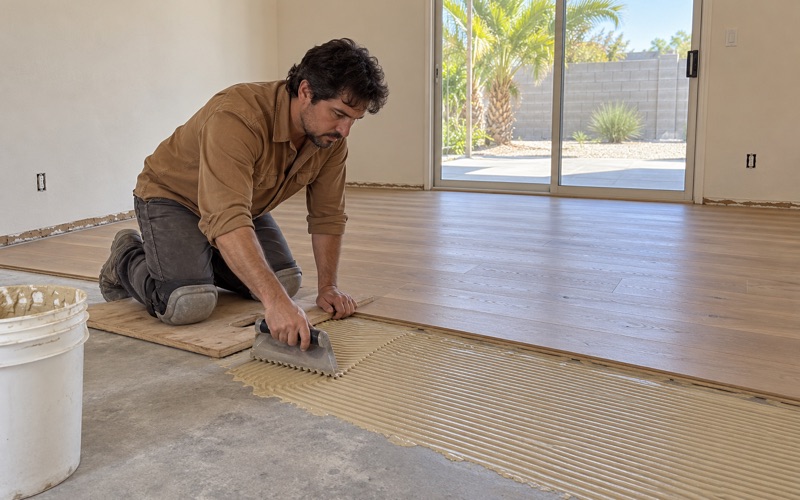
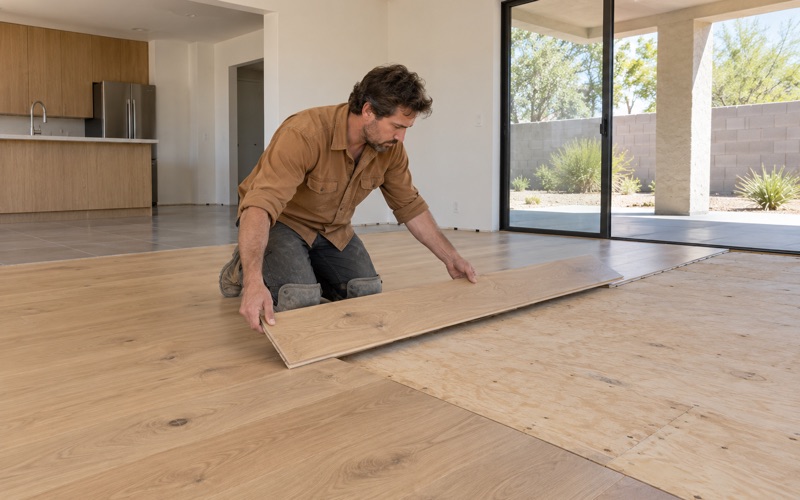
Replacement is the answer when boards are cupped or buckled from water, when engineered veneer is delaminating, or when earlier sanding has left too little wear layer to sand again. Before new material is ordered, we measure moisture content in the wood with a wood moisture meter and in any concrete slab, and we write the readings down.
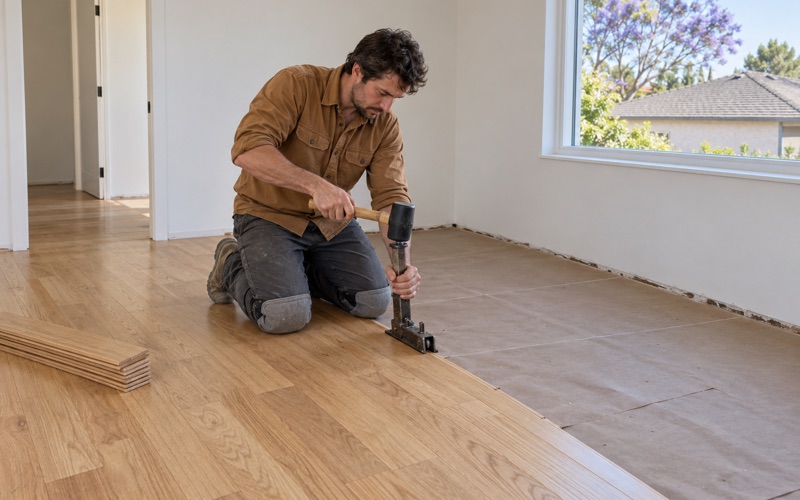
For a rental, durability usually drives species choice. A harder wood on the Janka hardness rating, such as white oak or hickory, stands up to furniture and pets better than a softer species, and a prefinished product shortens the time the unit sits empty.
Planning Rental Floor Work in Cypress
Turnover floor work goes best when it is planned before the keys come back. We can walk the unit with the owner during the notice period or right after move-out, then hand over a written, itemized estimate that separates each room and each type of work.
Older Paint and Old Adhesive
With 75.8 percent of Cypress housing built before 1980, many rentals fall under the EPA Renovation, Repair and Painting rule for pre-1978 housing. Floor work can disturb painted baseboards, shoe molding and door casings, so we follow lead-safe work practices on houses built before 1978, with containment and cleanup suited to a unit about to be shown.
Old flooring can raise its own question. Parquet adhesive, black mastic and 9x9 floor tile from these decades can contain asbestos, so we treat the adhesive as an asbestos question first, and an asbestos survey comes before any scraping or grinding. Where old parquet is in reasonable shape, we look at restoring or patching it before anyone talks about tearing it out.
Timing the Vacancy
Cure times vary by product, and a floor that is dry to the touch is not fully cured. Our written cure schedule lists each room, when it can be walked on in socks, when furniture can return and when rugs can go down, so the owner can book cleaners, a final walkthrough and a move-in date around it.
Cypress sits in the National Weather Service’s Orange County Inland forecast zone, and indoor humidity still shifts through the year. New boards need acclimation, so we let material settle in the house and check readings before installation rather than nailing it down the day it arrives.
Paperwork an Owner Can Use
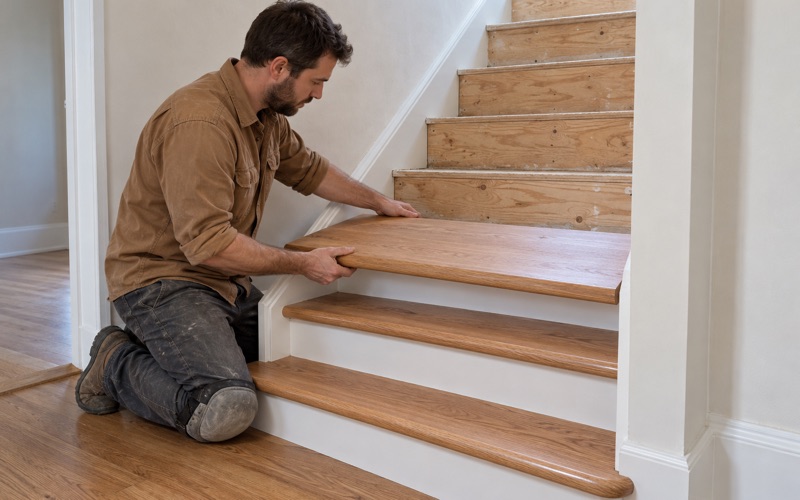
Rental floors generate paperwork: a move-out walkthrough, a scope for the next lease, sometimes an insurance claim after a leak. Our estimates are itemized so an owner, a tenant or an adjuster reads the same line items, and stairs are priced per tread and riser instead of folded into square footage. After water damage, we rebuild once the floor has dried and record photos and moisture readings an adjuster can use.
If a turnover uncovers a bigger problem, such as a subfloor gone soft at a doorway, we stop, show the owner and price it as a separate line rather than folding it quietly into the job. That keeps the decision with the owner, where it belongs, and keeps the vacancy calendar honest.
- 20+ Years in Wood Flooring
- Itemized Written Estimates
- Lead-Safe Sanding