
Buena Park Wood Flooring has installed engineered hardwood flooring in Buena Park, CA for 20+ years, serving surrounding cities including La Palma, La Mirada, Cypress, Cerritos, Stanton. We help you choose the plank, test what it is going onto, and install it nail-down, glue-down or floating depending on the subfloor in your house.
Engineered hardwood exists to solve one problem: solid wood moves as moisture changes, and some floors, especially concrete slabs, make that movement hard to live with. By bonding a real wood wear layer to a stable core, engineered planks stay flatter over concrete, in wider widths, and in rooms where solid hardwood would be a gamble.
That does not make every engineered plank a good one. The wear layer, the core and the finish vary enormously between products, and the difference decides whether the floor can ever be refinished or whether it is finished for good the day it goes down.
How an Engineered Plank Is Built
Wear Layer Thickness and Refinishing
The wear layer is the hardwood you walk on, and its thickness is the most important number on the product sheet. A thick wear layer can be sanded and refinished when the floor eventually shows its age, while a thin veneer can only be screened and recoated, and some rotary-peeled veneers should not be sanded at all.
We show you the cut end of each sample so you can see the wear layer for yourself. If you plan to stay in the house for many years, a thicker wear layer is money well spent; for a rental you plan to sell, a thinner one may be a reasonable choice.
Engineered Core Construction
Under the wear layer is the core, typically cross-laid plywood or a high-density fiberboard. A multi-ply plywood core resists moisture movement well and holds fasteners firmly, which makes it the usual choice for nail-down work. Fiberboard cores are dense and flat, and are common in click-together floating floors.
The core also determines how the floor behaves when it gets wet. A plywood core tolerates brief moisture better than most fiberboard, which is worth knowing in a kitchen or near an entry door.
Formaldehyde Labels on the Box
Engineered flooring is a composite wood product, so California regulates the formaldehyde in its core. Under 17 CCR 93120.2, CARB Phase 2 compliant hardwood plywood is limited to 0.05 ppm and MDF to 0.11 ppm, and a TSCA Title VI label shows the product meets the federal equivalent.
We check the labels on every product we install. If you want the strictest tier, look for flooring labeled no added formaldehyde, which we can source in most species.
Engineered Flooring Over a Concrete Slab
Testing the Slab Before Ordering
Concrete keeps giving off moisture long after it looks dry, and that moisture is the leading reason a wood floor on a slab cups, buckles or lets go of its adhesive. We test before material is ordered, using an ASTM F2170 in-situ relative humidity test, which reads moisture inside the slab, or a calcium chloride moisture test, which measures what the surface is releasing.
The readings are written down and kept with your estimate. They decide which adhesive or moisture barrier the floor needs, and they give you a record if the floor is ever questioned.
Glue-Down Installation and Moisture Control
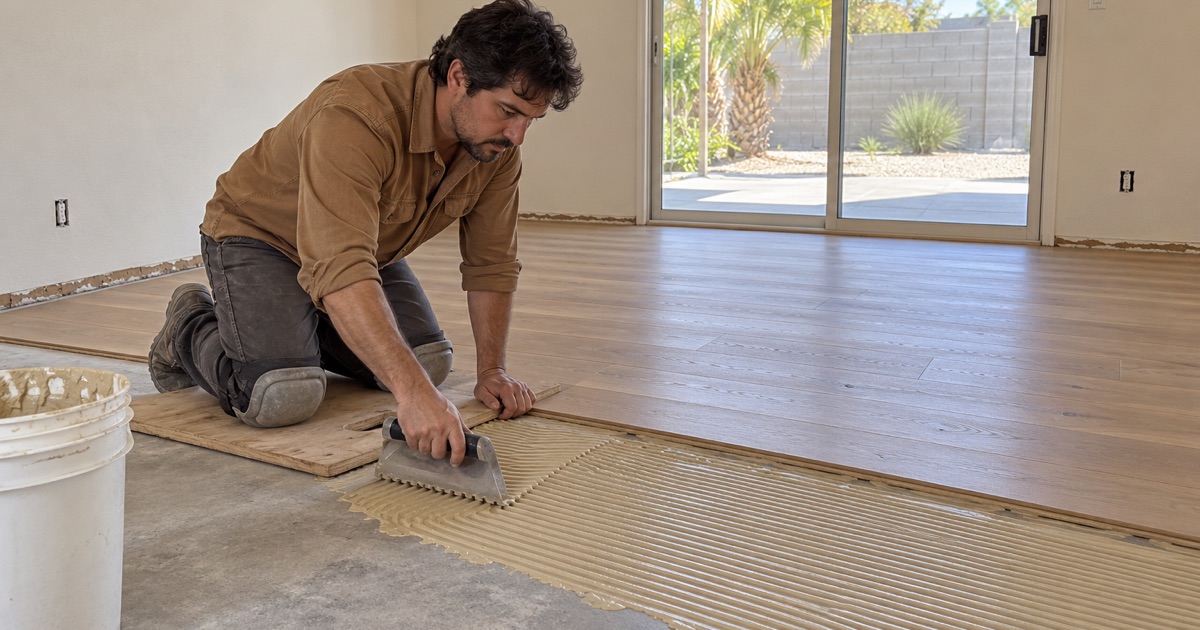
Glue-down installation bonds engineered planks directly to the slab with a flooring adhesive troweled across the concrete. It gives the most solid feel underfoot and no hollow sound. Where the slab reads damp, we use an adhesive that doubles as a moisture barrier or apply a separate vapor retarder first.
Old adhesive has to come off before new adhesive goes down. In older houses the residue may be black mastic, which can contain asbestos, so we test before any grinding.
Floating Installation Over Underlayment
A floating installation locks the planks together edge to edge over an underlayment, without glue or nails holding them to the slab. It is quicker, tolerates minor slab moisture better when the underlayment includes a vapor retarder, and can be removed later without destroying the slab.
The tradeoff is feel and sound, since a floating floor can sound hollow compared with glue-down. A dense underlayment and a flat slab make most of that difference disappear.
Choosing the Right Engineered Product
Species and the Janka Hardness Rating
The Janka hardness rating compares how well species resist dents, and it applies to the wear layer of an engineered plank just as it does to solid wood. White oak is the most popular choice for its tight grain and the way it takes both light and dark tones, while hickory resists dents better still, and maple gives a clean, pale floor.
The finish matters as much as the species for wear. A matte, wire-brushed surface on any of these hides scratches far better than a smooth gloss.
Wide Plank Engineered Flooring
Wide plank flooring shows more grain in each board and makes a room feel calmer, but wide solid boards move more with seasonal moisture and can cup. Engineered construction keeps wide planks flatter, which is why most wide plank floors installed over concrete are engineered rather than solid.
Acclimation and the Expansion Gap
Engineered planks still move a little, so we let them acclimate in the house before installation and leave an expansion gap at every wall, hidden under baseboard or shoe molding. Skipping either step is how a floor ends up buckling against a wall after its first humid season.
How long a product needs to acclimate depends on the manufacturer and on the difference between the conditions in the warehouse and the conditions in your house. We check the moisture content of the planks against the subfloor rather than simply counting days, and install once the two are within the range the manufacturer specifies.
Prefinished Versus Site-Finished Engineered
Most engineered hardwood arrives prefinished, with a factory finish cured under ultraviolet light that is ready for furniture the day the floor is installed. That makes it the practical choice for a family living in the house, since there is no sanding, no finish odor and no cure time.
Site-finished engineered flooring is installed raw, then sanded and coated in place like a traditional floor. It gives a perfectly flat, seamless surface with no beveled edges, and it lets you choose any stain color, but it needs a thick enough wear layer to sand and a household willing to wait out the cure.
Condos, Upstairs Rooms and Transitions
Acoustic Underlayment for Condos
In condos and upstairs units, hardwood carries footsteps to the neighbors below. Most associations require an acoustic underlayment rated for impact sound, often by its delta IIC rating, and approve the floor before work begins.
We gather the product data your board asks for, including the underlayment rating, and install to the specification it approves. Communities such as Laguna Woods Village publish their own alteration standards, and we follow whichever set applies to your building.
Transitions to Tile, Carpet and Other Rooms
Engineered hardwood often ends up a different height from the tile or carpet next to it. We finish each edge with a reducer strip, T-molding or threshold chosen for the height difference, and trim door bottoms where needed so everything still swings freely.
Nail-Down Engineered Over a Wood Subfloor
On a raised foundation or a second floor with a plywood subfloor, engineered planks can be nailed or stapled down like solid hardwood. We check the subfloor for flatness and soft spots first, and follow NWFA installation guidelines for fastener type and spacing so the floor stays tight and quiet.
Nailing also makes future repairs simpler, because a damaged plank can be cut out and a new one set in without disturbing adhesive or a floating system. For floors on a second story, that ease of repair is often the deciding factor between nail-down and floating.
- 20+ Years in Wood Flooring
- Itemized Written Estimates
- Lead-Safe Sanding