
Buena Park Wood Flooring has handled hardwood floor repair in Buena Park, CA for 20+ years, serving surrounding cities including La Palma, La Mirada, Cypress, Cerritos, Stanton. We replace damaged boards, stop squeaks, close up gaps, and repair stain, water and pest damage so the fix blends into the floor that is already there.
Most hardwood floors do not need replacing when something goes wrong. A handful of stained or split boards, a squeak in the hallway, or a gap by the back door can almost always be repaired in place, and a good repair costs a fraction of a new floor while keeping the wood you already have.
The skill is in the matching. We identify the species, width and cut of your boards, source or salvage matching wood, and weave it into the pattern so the repaired area reads as part of the original floor rather than a patch.
Repairs We Make to Hardwood Floors
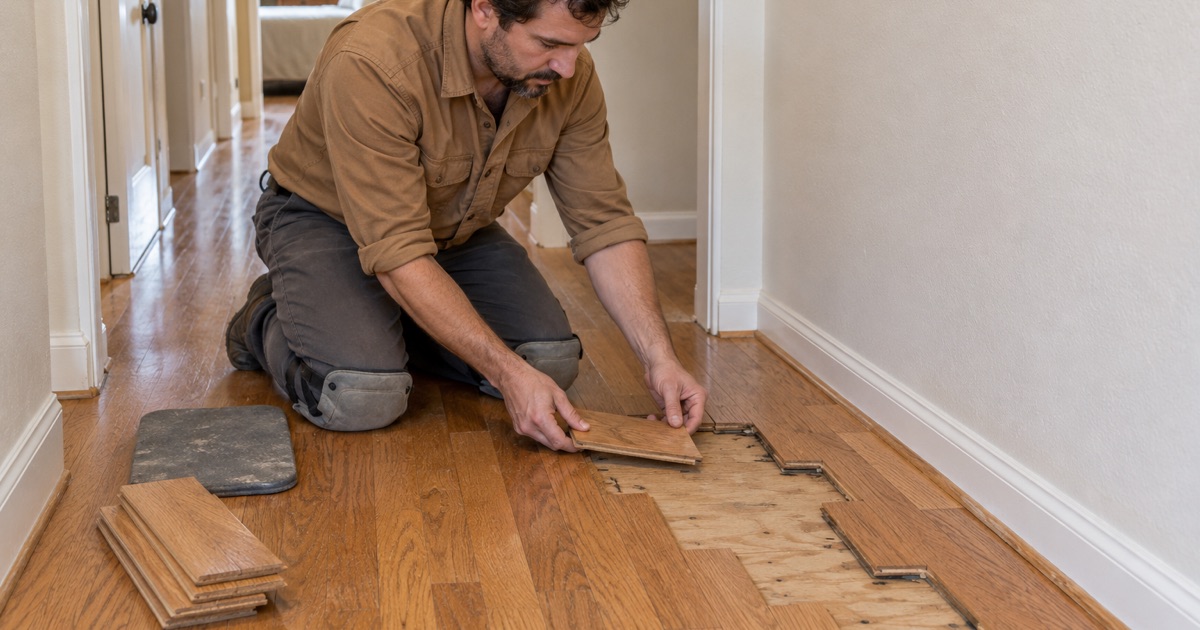
Board Replacement and Weave-In Repair
When individual boards are cracked, stained, burned or split, we cut them out along their length without damaging the tongue and groove of the boards around them. New boards go in with their end joints staggered to follow the existing pattern, a technique called a weave-in repair.
A square patch looks like a patch no matter how well it is finished. A weave-in repair follows the random stagger of the original floor, which is why, once sanded and finished, most people cannot find it.
Squeaks and Loose Boards
Squeaks come from boards rubbing against each other or against the nails that hold them, usually because a board has loosened from the subfloor or the subfloor has loosened from a floor joist. We locate the source and refasten from below through the crawlspace where we can, or from above with specialty screws that break off below the surface.
A squeak that is paired with a soft spot is a different problem. That often points to a subfloor that has rotted or delaminated, and we check it before refastening anything.
Gaps, Cupping and Crowning
Board gaps, cupping and crowning are symptoms of moisture movement, so the repair starts with a wood moisture meter rather than a sander. Seasonal gaps that close in humid months are left alone, while permanent gaps can be filled with wood slivers or the boards relaid.
Cupped boards often flatten once the moisture source is fixed and the floor dries out. Sanding them flat while they are still wet is the classic mistake, because the floor then crowns once it dries.
Damage With a Cause Underneath
Pet Urine Stains and Odor
Pet urine soaks through the finish into the wood and reacts with it, leaving dark gray or black stains and an odor that returns on humid days. Light surface marks can sometimes be sanded out, but deep stains usually go through the board, and the only reliable fix is to replace those boards.
We also check the subfloor beneath heavily stained areas. If urine has soaked through to the plywood, the smell can persist even with new boards on top, so we seal or replace that section too.
Termite and Powderpost Beetle Damage
Drywood termites hollow out wood from the inside and leave small piles of termite frass, while powderpost beetles leave fine powder and tiny round exit holes. Either can leave a board that looks fine on top but crushes under a heel.
We replace damaged boards once the pest company has treated the house, since new wood laid into an active infestation is just more food. If termite fumigation is scheduled, we plan the repair and any refinishing for after the tent comes down.
Water Stains and Black Spots
White marks on a hardwood floor usually sit in the finish and can sometimes be removed by refinishing, but black spots mean water has reached the wood itself and reacted with the tannins in oak. Those rarely sand out completely.
Before replacing stained boards, we trace where the water came from, whether it was a plant pot, a pet bowl or a slow leak, and confirm the area is dry with moisture readings.
Matching the Repair to the Floor
Species, Width and Grade Matching
Most floors in this area are red or white oak strip in a few standard widths, which are still easy to source. We match the species, the cut, the width and the thickness, and for unusual floors we salvage boards from a closet or from under an appliance and replace those with new stock instead.
Blending Stain and Finish
New boards are sanded flush with the surrounding floor, then stained and finished to match. We test the stain on a scrap or on the new boards before committing, since a new board and an aged board take the same stain differently.
Where the existing finish has aged heavily, the most invisible repair is to refinish the whole room after the boards are in. We tell you which approach your floor needs when we write the estimate.
Parquet Block Repair
Loose or missing parquet blocks can be reglued or replaced with matching ones, but older parquet adhesive can contain asbestos. We handle loose blocks without disturbing the adhesive where we can, and arrange an asbestos survey before any grinding or scraping of the old glue.
Replacement blocks are cut from matching species and set into the pattern, then the area is sanded and finished with the rest of the floor. Where a parquet floor has many loose blocks, we check for moisture underneath first, since widespread loosening usually has a cause.
Stair Tread and Nosing Repairs
Stairs take more wear than any other part of a hardwood floor, and the stair nosing at the front edge of each tread is where it shows first. A cracked tread, a loose nosing or a split riser can usually be replaced on its own, matched to the other steps, and finished to blend.
A loose nosing is also a trip hazard, so we treat it as a priority repair rather than a cosmetic one. We refasten or replace it and check the steps above and below for the same problem.
Repairs for Sales, Rentals and Claims
Items From a Home Inspection
A home inspection report may flag damaged boards, squeaks, cupping or soft spots without estimating the repair. We inspect each listed item, give you a written estimate for it, and separate cosmetic items from those that point to a real problem below the floor.
For sellers, that estimate can be attached to disclosures or used to make repairs before listing. For buyers, it puts a real number on what the report found, which is far more useful in a negotiation than a general note that the floor needs attention.
Rental Turnover and Deposit Disputes
Between tenants, landlords need damaged boards replaced quickly and documented clearly. Under California Civil Code 1950.5, a landlord may deduct from a security deposit for damage beyond normal wear and tear, and our itemized estimate describes each repair so owners and tenants can see what was damage and what was ordinary aging.
Repairs Covered by Insurance
When a covered loss damages part of a floor, the repair has to blend with what remains. California’s 10 CCR 2695.9 calls for replaced items to reach a reasonably uniform appearance, so we photograph the damage, take moisture readings, and explain in the estimate why a room may need more than the damaged boards replaced to match.
We work from the adjuster’s scope where one exists and note any item we believe it missed, such as baseboard removal or refinishing an adjoining area for a consistent finish. That keeps the conversation about specific line items rather than about two totals that do not agree.
- 20+ Years in Wood Flooring
- Itemized Written Estimates
- Lead-Safe Sanding