
Buena Park Wood Flooring has installed hardwood stair treads in Buena Park, CA for 20+ years, serving surrounding cities including La Palma, La Mirada, Cypress, Cerritos, Stanton. We replace carpeted and worn stairs with new hardwood treads, risers and nosings, refinish existing wood stairs, and match the finished staircase to the floor above and below it.
Stairs take more hand work than any other part of a wood floor. Each step is measured, cut and fitted on its own, and small differences in the framing underneath mean no two treads are quite the same, so a staircase that looks simple on paper can take as long as a whole room of flooring.
That is why our estimates list the stairs as a count of treads and risers with a price for each, separate from any square-foot price for the floor. You see exactly what the staircase costs, and you can compare it with other estimates on the same basis.
Stair Tread and Riser Options
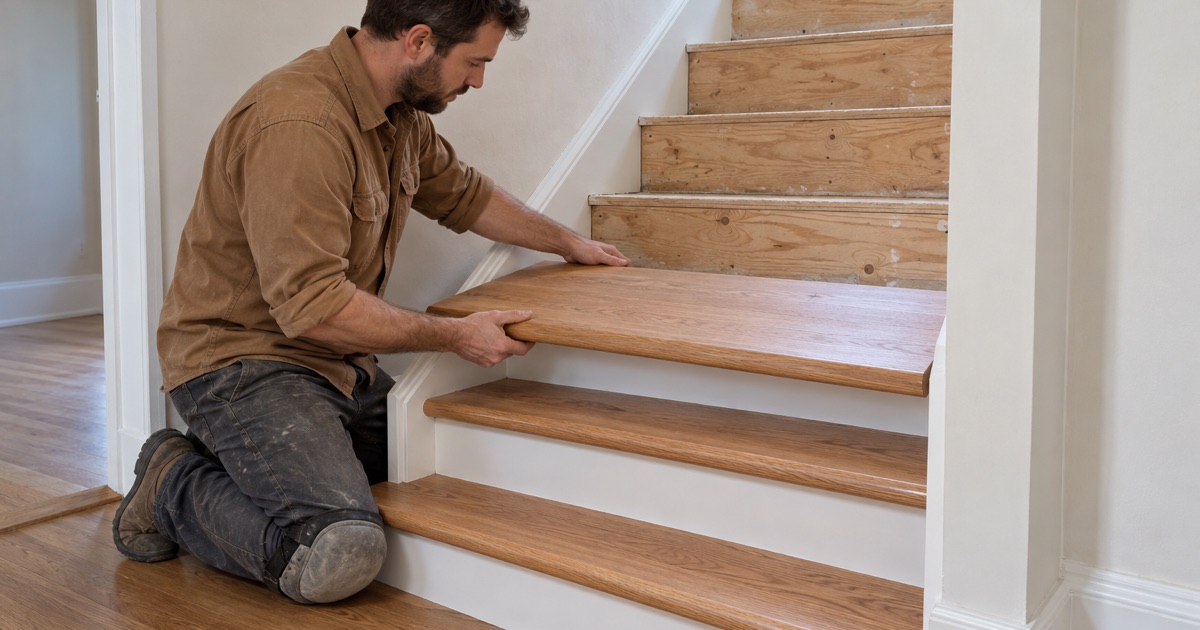
Solid Hardwood Stair Treads
A stair tread takes the hardest wear in the house, so we use solid hardwood treads rather than thin veneers. Oak is the traditional choice and matches most floors, while hickory offers more dent resistance for busy households. Treads are available unfinished for staining on site or prefinished to match a prefinished floor.
Each tread is cut to the exact width of its step, since walls and stringers are rarely perfectly square, and scribed where it meets a wall or a skirt board. That fitting is what separates a staircase that looks built-in from one where gaps show at the ends of every step.
Risers and Their Finish
The stair riser is the vertical face between treads. It can match the treads in wood, or be painted white or a contrasting color, a popular look that also hides scuffs from shoes. We install new risers when the old ones are damaged or when capping the steps changes their height.
Painted risers are usually primed and painted before the treads go in, then touched up at the end, which gives crisp lines where paint meets wood. Wood risers are stained and finished with the treads so the whole staircase ages evenly.
Stair Nosing Profiles
The stair nosing is the rounded front edge of each tread, and where the staircase meets the floor above, a separate landing nosing finishes the edge. We choose a nosing profile that matches the thickness of your floor, so the transition from the hallway to the top step is flush and clean.
On open staircases, where the side of the tread is visible, we return the nosing around the exposed end so the edge looks finished from every angle. It is a small detail, but it is one of the first things a visitor notices on the way up.
Converting Carpeted Stairs to Hardwood
What Is Under the Carpet
Many carpeted staircases have rough framing lumber or particleboard steps underneath rather than finished wood, which cannot be refinished. Some have oak treads that were covered for comfort and can be sanded and refinished. We pull back a corner of carpet to see which you have before we price the job.
Even where oak treads are found, the risers underneath are often plain lumber or plywood that was never meant to be seen. In that case we refinish the treads and install new risers, or paint the old ones, so the finished staircase looks complete.
Capping Existing Steps
Where the existing steps are structurally sound, we cut back the overhang, then install new treads and risers over them. This avoids demolishing the staircase, keeps the work cleaner, and is usually faster and less costly than a full rebuild.
Each new tread is glued with construction adhesive and fastened to the step below, which keeps it silent underfoot. Squeaks on an old staircase usually come from treads that have loosened from their stringers, so we refasten those before capping them.
Keeping Step Heights Even
Adding new treads raises every step slightly, and the floor at the top and bottom must be accounted for so the first and last risers stay close in height to the rest. An uneven step is a trip hazard, so we plan the heights before any tread is cut.
Refinishing Existing Wood Stairs
Sanding Stairs by Hand
Stairs cannot be sanded with a drum sander, so each tread and riser is sanded with smaller tools and by hand. We remove old finish, carpet tack strip holes and staples, and fill damage before staining and finishing.
The stair is finished in stages so the household can still get upstairs, usually alternating steps or working one side at a time. We tell you in writing which steps can be used when, so nobody steps on wet finish on the way to bed.
Painted Stairs in Older Houses
In a house built before 1978, old paint on stair risers, stringers and balusters is treated as possibly containing lead. We follow the EPA Renovation, Repair and Painting rule, contain the area, and use dust-extracting tools while stripping or sanding it.
Safety and Finish
Grip and Sheen
A high-gloss finish on stair treads can be slippery, especially in socks. A satin or matte sheen level gives more grip underfoot, and we use a finish that meets the South Coast limit of 275 g/L under SCAQMD Rule 1113.
For homes with young children, older relatives or dogs, a stair runner fastened down the center of the treads adds grip and softens footsteps while leaving the wood visible at each side. We can install the treads with a runner in mind, finishing the exposed edges to match the floor.
Loose Treads and Nosings
A loose tread or a cracked nosing is a fall risk, not only a cosmetic problem. We refasten loose treads to the stringers, replace damaged nosings, and check the rest of the staircase for the same issue while we are there.
A loose handrail or baluster is often found at the same time. We point it out, and where it is part of the staircase we are working on, we secure it so the whole stair is safe when we leave.
- 20+ Years in Wood Flooring
- Itemized Written Estimates
- Lead-Safe Sanding