Buena Park Wood Flooring brings more than 20 years of work to wood flooring in Hermosa Beach, and this page covers one narrow slice of it: floors in the homes that sit nearest the sand. Those houses take two kinds of traffic from the beach side, fine grit on every shoe and bare foot and, far less often, storm water, and both shape how we plan a floor.
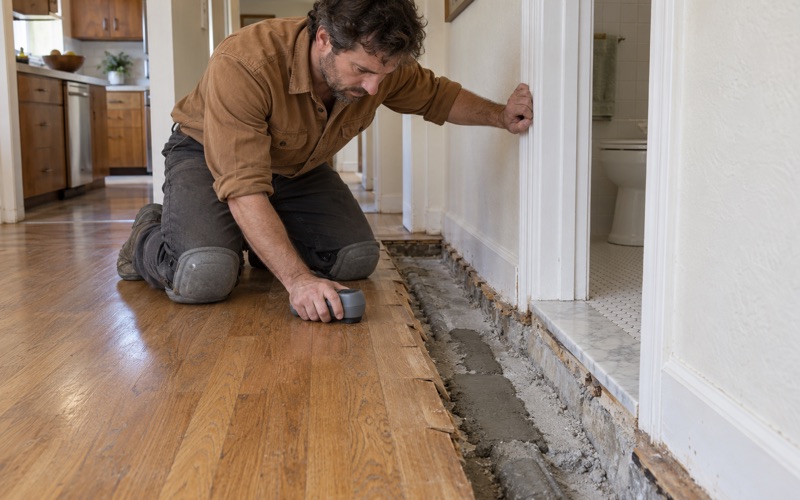
We start every job with readings rather than guesses. A wood moisture meter goes on the boards, and where a room sits on concrete we test that concrete before anything is ordered, then write the numbers down so an owner, landlord or adjuster can see exactly what we saw.
From there the choices follow the room: which species and construction suit a lower level, which finish holds up to grit, and how long each space stays off limits after coating. The sections below walk through the beachfront setting, the rooms below grade, and the daily wear that sand carries through the door.
Wood Floors on The Strand’s First Row
Homes that face the sand
In Hermosa Beach the first row of homes faces the beach across The Strand, the walkway the Coastal Commission describes as running about four miles from 45th Street to Herondo Street. The Commission treats lots between the first public road and the sea as shoreline development, and its reports on them show how seriously it takes the beach side of a house.
That matters to a floor for a practical reason. Water and sand in these homes arrive from the same direction, through the doors and openings that face the beach, and the rooms nearest that side take the most punishment. We plan thresholds, transitions and finish around that exposure rather than treating the ground floor like any inland room.
The 2007 review at 820 The Strand
One file makes the setting concrete. In 2007 the Commission reviewed application 5-07-335 at 820 The Strand, about a quarter mile south of the pier, where a five-unit apartment building originally built over 60 years earlier was to be replaced by a two-story single-family house over a basement level. The lot had roughly 350 feet of sandy beach between it and the mean high tide line.
Staff put the question plainly: “The major issue with this beachfront development is that it could be affected by wave attack and flooding during strong storm events.” A coastal hazard and wave runup study by GeoSoils was part of the file, and the report notes that such a study is consistently required for shoreline development in southern Los Angeles County and Orange County.
What the study found, and what was imposed anyway
The study’s conclusion was reassuring. It found that shoreline erosion, wave runup attack and coastal flooding would not significantly impact the property over the life of the house, and it made no recommendations for wave runup protection. By that analysis, the wide beach in front of the lot was doing its job.
The Commission still attached conditions. The owners acknowledged that the site may be subject to hazards from “flooding and wave uprush,” accepted that no shoreline protective device would ever be built, and recorded a deed restriction carrying those terms. Those conditions bind that one parcel; we cite them because they show what a beachfront owner may be asked to plan around.
Looking for wood-flooring closer to Laguna Woods? See Wood-Flooring Services in Laguna Woods.
Below-Grade Rooms in Beachfront Homes
A basement on a beachfront lot
The 820 The Strand plan called for 334 cubic yards of cut to create the basement level, and its drainage ran to an infiltration basin and porous rain tanks with an attached sump pump. A lower level on a lot like that is a real room, often a media room, guest suite or gym, and owners understandably want wood down there.
Wood can work below grade, but only after the concrete has told us what it holds. A room built into the ground a short walk from the ocean earns more testing than an upstairs bedroom, and we would rather lose a day to readings than lose a floor to moisture nobody measured.
Testing the concrete before ordering
On a below-grade slab we use the ASTM F2170 in-situ relative humidity test, setting probes into the concrete and letting them equilibrate before we read them. Where a quick surface read helps, a calcium chloride moisture test adds a second number. Both results go into the written estimate with the date, the room and the location of each test.
We also track the moisture content of the flooring itself during acclimation, because boards that arrive dry and meet a damp lower level will move. The goal is to install when the wood and the room are close to each other, and to show the owner the readings that support the timing instead of asking for trust.
Choosing a floor for a lower level
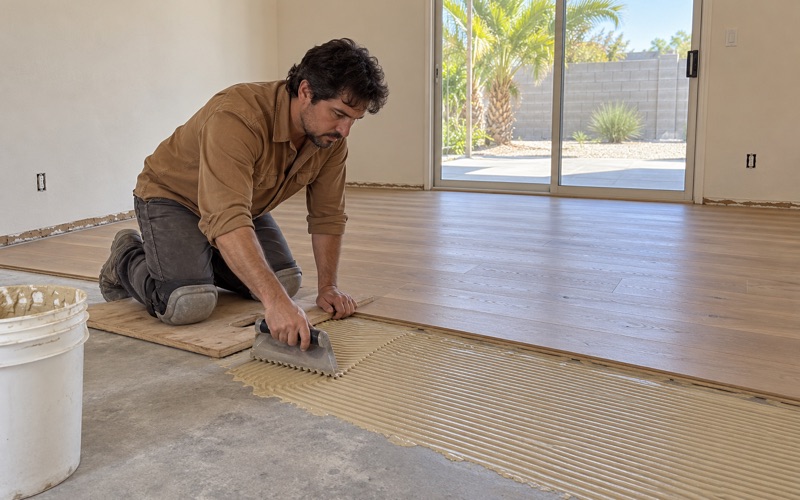
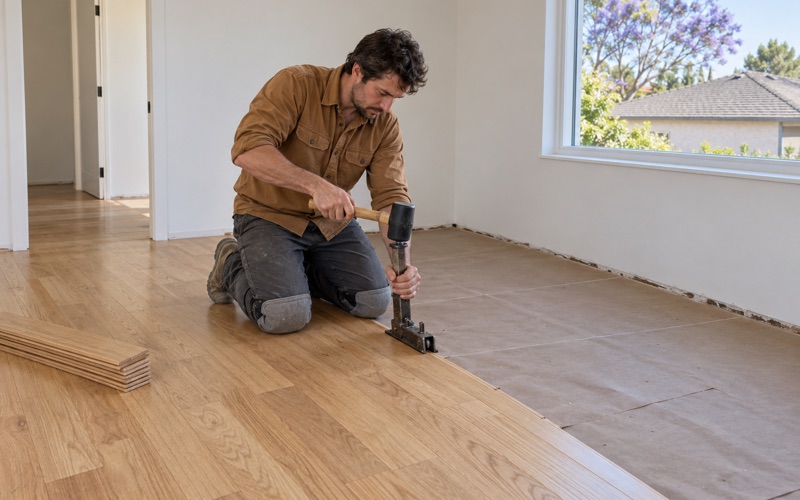
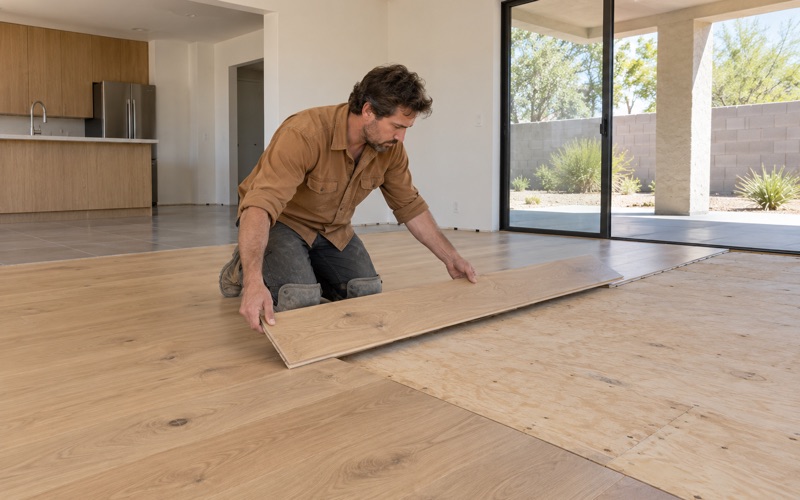
Solid strip nailed over concrete is rarely the right answer below grade. Engineered flooring with a stable core construction, installed as a glue-down or floating installation over a vapor retarder the manufacturer approves, handles a lower level far better. Wear layer thickness decides how many future sandings the floor can take, so we discuss it before choosing a product.
We leave a proper expansion gap at the walls, hide it under shoe molding, and plan the transition where the stair lands. If a lower-level floor ever does take water, a floating floor can often be lifted and dried in sections, and we rebuild after drying with photos and moisture readings an insurance adjuster can use.
Sand, Doors and Finish Wear at the Beach Edge
What grit does to a finish
Sand tracked in from The Strand acts like fine sandpaper under shoes and bare feet. It dulls a glossy coat first, then scratches through to the wood along the paths people walk most, usually from the beach-side door to the kitchen and stairs. A harder species helps, and white oak and hickory rank higher on the Janka hardness rating than many softer choices.
Hardness only slows the damage, so the finish carries more weight. A lower sheen level hides fine scratches that a high gloss shows in every slant of afternoon light, and a tough waterborne polyurethane or an oil-modified polyurethane gives a durable surface. Some owners prefer a hardwax oil finish because worn spots can be refreshed locally.
Recoating before the wood wears
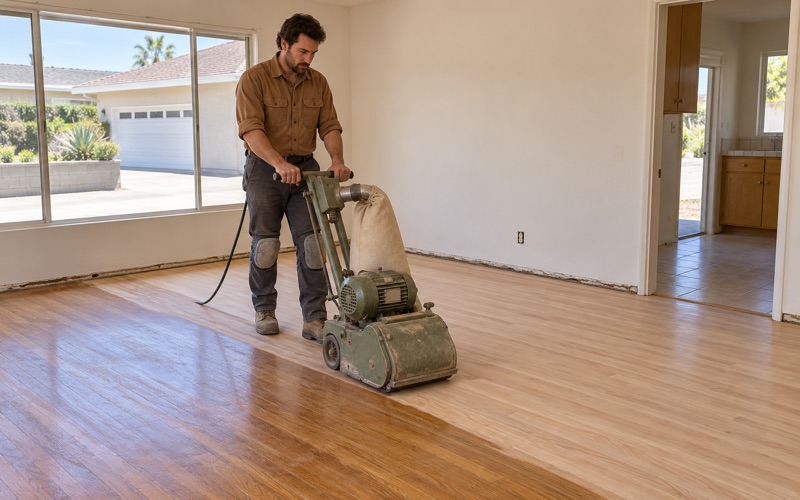
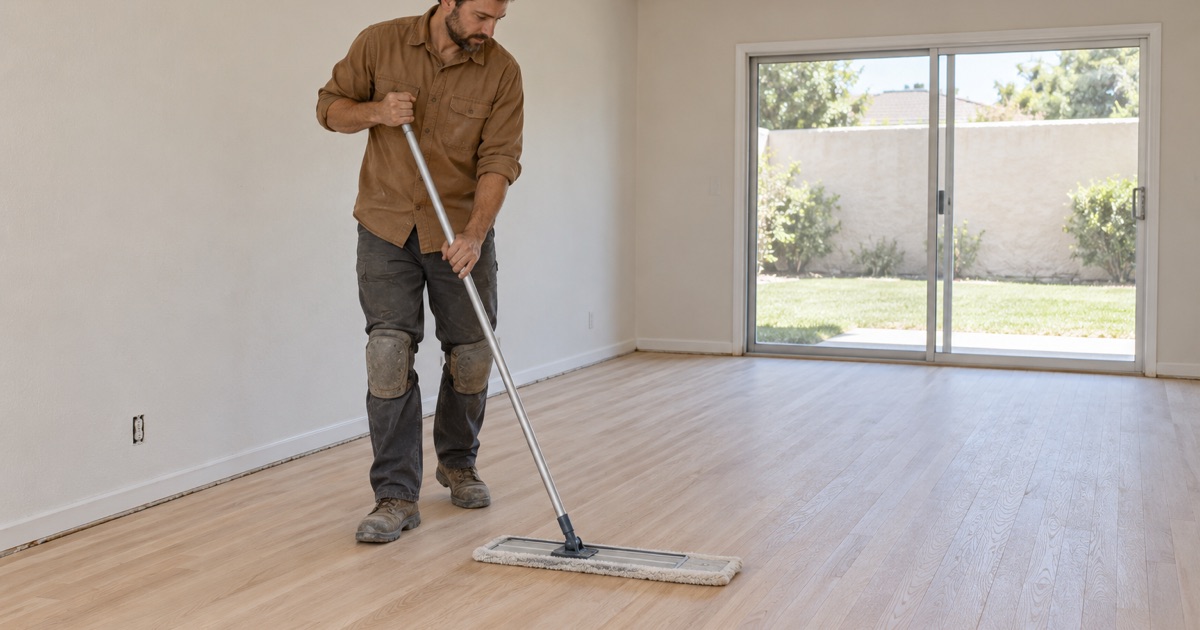
The cheapest refinish on a beach house is the one done early. When the finish is dull but intact, a screen and recoat abrades the top layer and adds fresh coats without taking the floor down to bare wood. Wait until grit reaches the boards, and a full sand with a drum sander, an edger and a careful grit sequence becomes the job instead.
Every finish we apply is chosen from products legal in the South Coast air basin under SCAQMD Rule 1113, which holds wood coatings to 275 g/L of VOC. We use a dustless sanding system where the room allows it, and we hand over a written cure schedule so the household knows when each room can take foot traffic and furniture again.
Doors, thresholds and soft spots
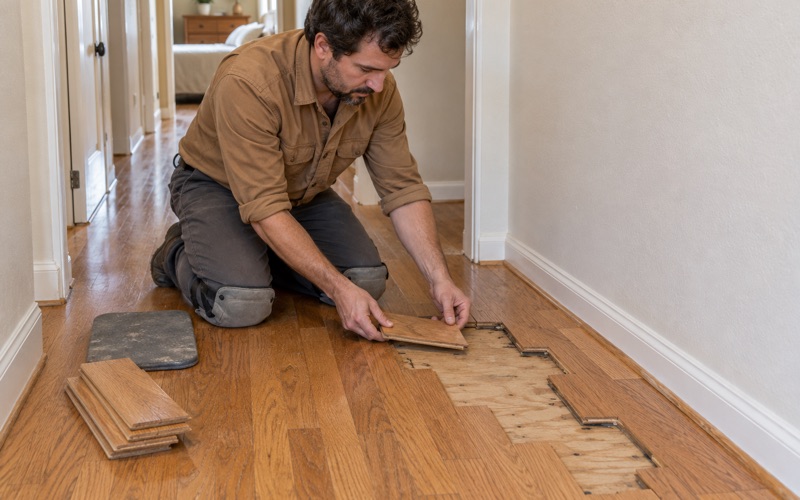
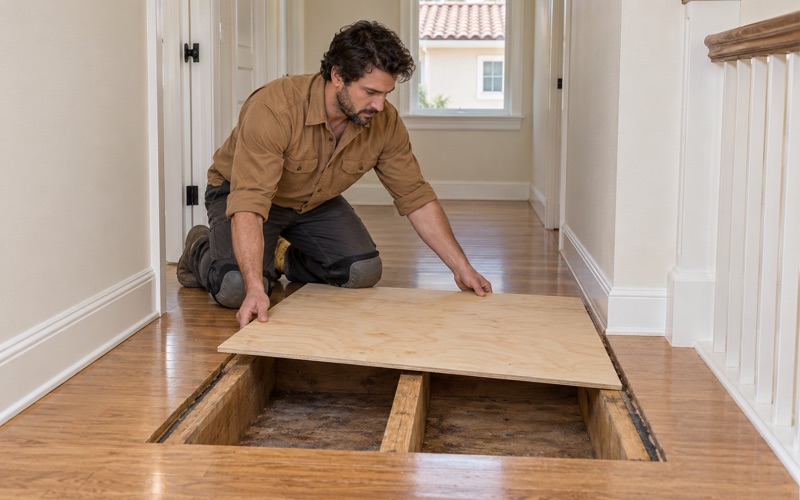
Beach-side doors are where water and sand meet the floor most often. We look closely at boards near those openings for cupping, gray staining or a soft feel underfoot, and when we find soft spots we trace them to the subfloor before pricing any finish floor. A weave-in repair or targeted board replacement can often save the rest of the room.
A reducer strip or T-molding at the threshold protects the board ends and gives the finish a clean edge to stop at. Entry mats on both sides of the door do more for a floor here than almost anything else we could sell, and we say so plainly in the estimate.
Planning Floor Work in Hermosa Beach
Older buildings near the beach
The building at 820 The Strand was more than 60 years old when it was replaced, and it was not unusual. Census estimates put 11.2 percent of Hermosa Beach housing units before 1940 and 70.5 percent before 1980. In any house built before 1978 we follow lead-safe work practices under the EPA Renovation, Repair and Painting rule during sanding and tear-out.
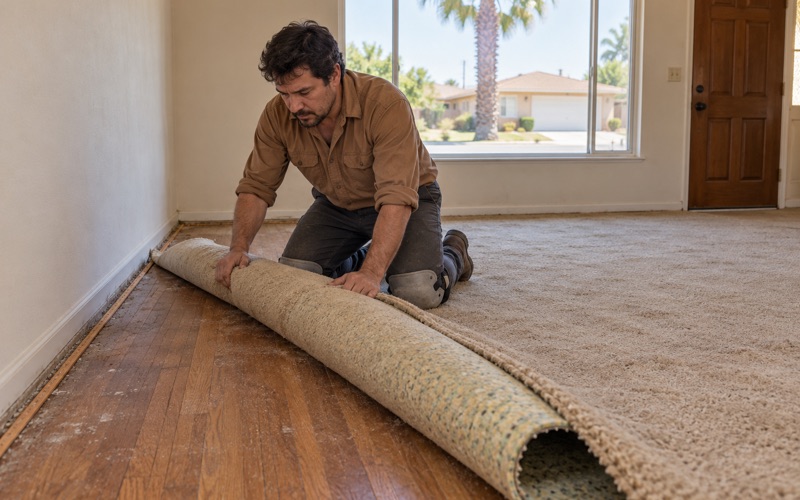
Older floors can also hide layers. Where we find old parquet or 9x9 tile, we treat the adhesive or black mastic underneath as a possible asbestos question first and arrange an asbestos survey before any scraping. Oak strip found under carpet is assessed board by board, with tack strip holes and staple damage noted, before anyone talks about replacing it.
Paperwork and coordination
Building and coastal questions belong to the City of Hermosa Beach Community Development Department and, near the shoreline, the California Coastal Commission. We do not guess at approvals for anyone’s project; we point owners to those offices and keep our side of the job clear, with a written, itemized estimate a landlord, seller, tenant or insurance adjuster can read line by line.
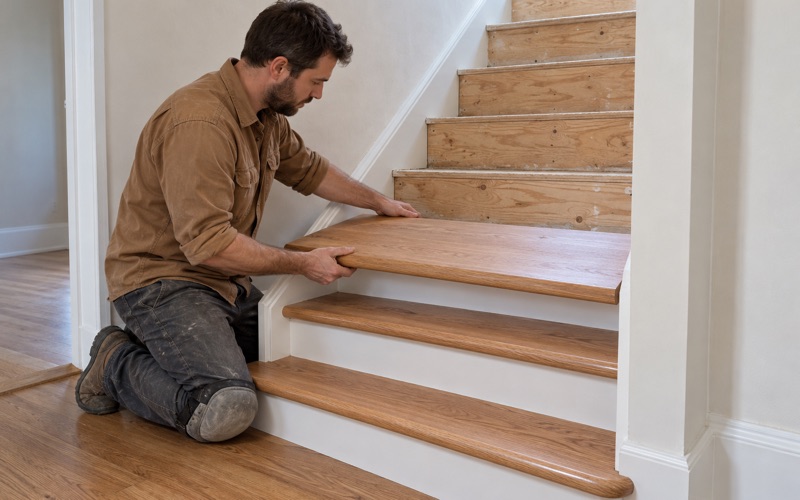
Stairs from the living level down to a basement are priced per tread and riser, with stair nosing listed separately, rather than folded into a square-foot figure. That makes options easy to compare and shows exactly where the money goes in a home where the lower level and the stair often need different materials.
How a job runs
A typical beachfront job starts with a walk-through, moisture readings in the wood and in any concrete, and a close look at the beach-side doors. We then write the estimate, order material once the numbers support it, and schedule installation or refinishing room by room so the household can keep using part of the house.
After the final coat we leave the cure schedule on site and walk the owner through care for a floor that will see sand every day: mats at the doors, felt pads under furniture, a soft broom instead of grit ground in by a beater bar, and an early call for a recoat when the sheen starts to fade.
- 20+ Years in Wood Flooring
- Itemized Written Estimates
- Lead-Safe Sanding