Buena Park Wood Flooring brings more than 20 years of work to wood-flooring in La Habra, and most of what we are asked to look at here is a floor that has simply worn out in a house its owner has lived in for a long time. Some of those owners are paying for the work themselves. Others are waiting to hear whether public repair money will reach them.
Either way, the first job is the same: find out what is actually wrong under the finish floor before anyone prices boards. A floor that sags, squeaks or lifts near a bathroom is often telling you about the structure beneath it, and a replacement laid over an unresolved problem fails early and costs twice.
This page walks through how we approach floor repair and replacement in La Habra’s owner-occupied houses, what the city’s own rehabilitation program says about flooring, and how to put together a scope that holds up whether the money comes from your savings or from a program file.
Interior Flooring on La Habra’s Own Repair List
The City of La Habra runs a Home Improvement Grant & Loan Program, also called the Residential Rehabilitation Program, through its Housing Division. Its list of eligible repairs names “Interior flooring” outright, next to structural repairs, plumbing, building code violations, fumigation, interior painting and re-roofing. Floors are not an afterthought on that list; they sit alongside the repairs the city treats as basic to a sound house.
Who the program is written for
The program serves owner-occupants of single-family housing and mobile homes located within the city boundaries, and household income guidelines apply. The city’s CDBG page describes the same goal as rehabilitation help for existing low- and moderate-income owner-occupants. Renters and landlords are not the audience, and neither is a house the owner does not live in.
Closed to new applications, with a waitlist
The city page is plain about timing: it is not accepting new applications right now. Owners who want a place in line are directed to call the Housing Division at (562) 383-4108 to be put on the waitlist. We are not part of that process and cannot speed it up, so we tell every caller to treat the call to the city as a separate step they take themselves.
The scale matters too. The draft 2025-2026 Annual Action Plan budgets $100,000 of CDBG money for Residential Rehabilitation and estimates it will help 2 homeowners, out of roughly $594,000 in CDBG funds the city expects for that program year. That is a small number of houses, and it is a good reason to understand your floor well before you depend on any one path to fix it.
Why flooring shows up next to plumbing and structure
The action plan says the repairs are meant to correct hazardous structural conditions and building and health code violations. In a floor, those problems usually arrive together: a slow leak rots a subfloor, the subfloor goes soft, and the finish floor becomes a tripping hazard. Treating flooring as part of the house’s structure, rather than as decoration, is the right frame for any La Habra owner.
Looking for wood-flooring closer to Santa Fe Springs? See Wood-Flooring Services in Santa Fe Springs.
The Houses Behind the Floors: 1950s and 1960s La Habra
La Habra’s housing is overwhelmingly postwar. Of the city’s 21,225 housing units, 6,012 were built in the 1950s, which makes that decade 28.3 percent of the stock and the largest single building period. Another 4,089 went up in the 1960s, and 76.6 percent of all units predate 1980. Only a small share is older than 1940.
Detached, owner-occupied, and lived in for decades
Ownership here runs through detached houses. Of the 11,972 owner-occupied households, 9,316 live in detached homes, which is 77.8 percent. That is the house type where a single family has often refinished, carpeted, re-carpeted and patched the same rooms across several generations of flooring, and where we expect to find layers rather than one clean surface.
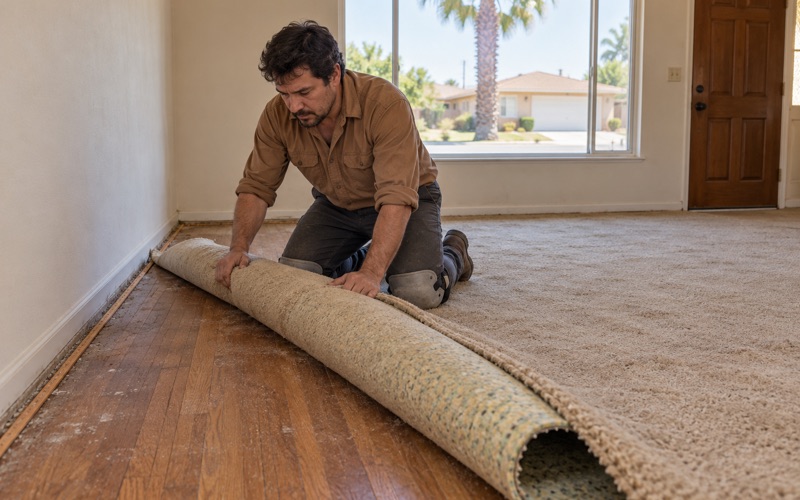
We do not assume what is under those layers. When we lift a corner of carpet in a postwar house, we record what we see, identify the species and milling where we can, and check whether the boards are still sound enough to sand. What is there is a finding, not a promise, and we price from the finding.
Lead-safe practices and old adhesives
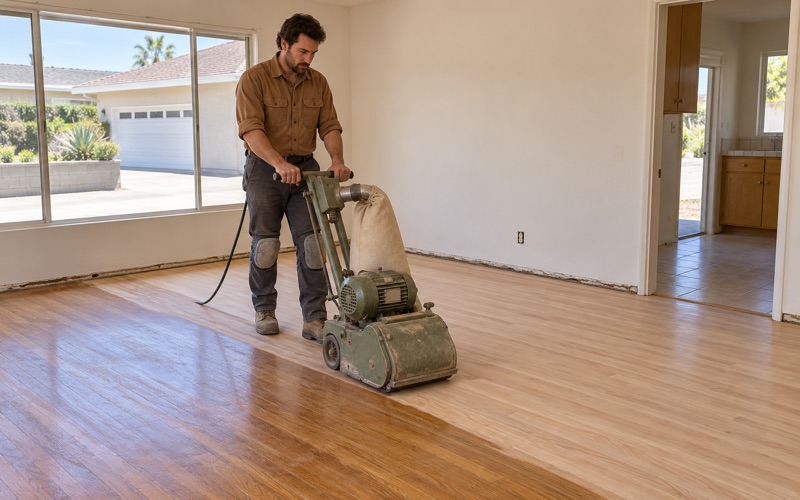
With three quarters of the stock built before 1980, most houses we enter in La Habra fall under the EPA Renovation Repair and Painting rule for pre-1978 housing. We follow lead-safe work practices when sanding, cutting or removing painted trim such as shoe molding and baseboard, and we contain dust with a dustless sanding system rather than an open drum sander pass.
Old resilient tile and the black mastic under parquet or 9x9 asbestos floor tile get the same caution. We treat any adhesive of that age as a possible asbestos question and recommend an asbestos survey before removal, because SCAQMD Rule 1403 governs how that material is handled once disturbance begins.
Scoping a Floor Repair While You Wait
A waitlist is time, and time is useful if it is spent learning what the floor needs. We can assess a La Habra floor, measure it and write an itemized scope an owner can keep on file, hand to any contractor, or use to decide whether to pay for the most urgent part now and hold the rest.
Start below the finish floor
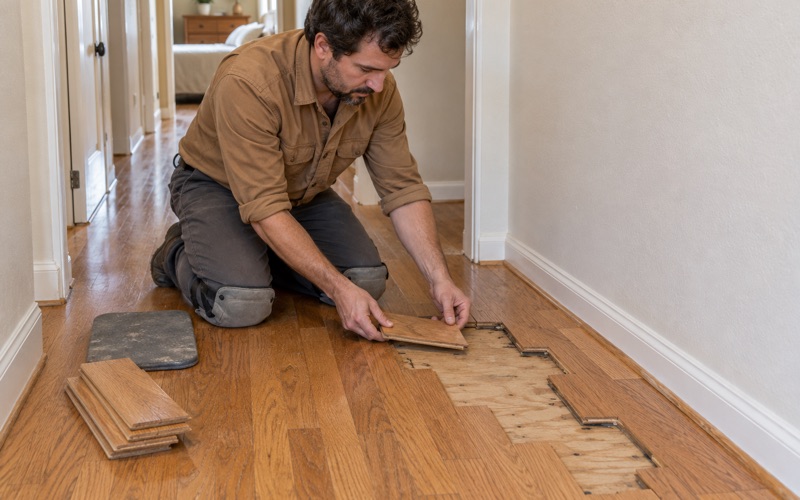
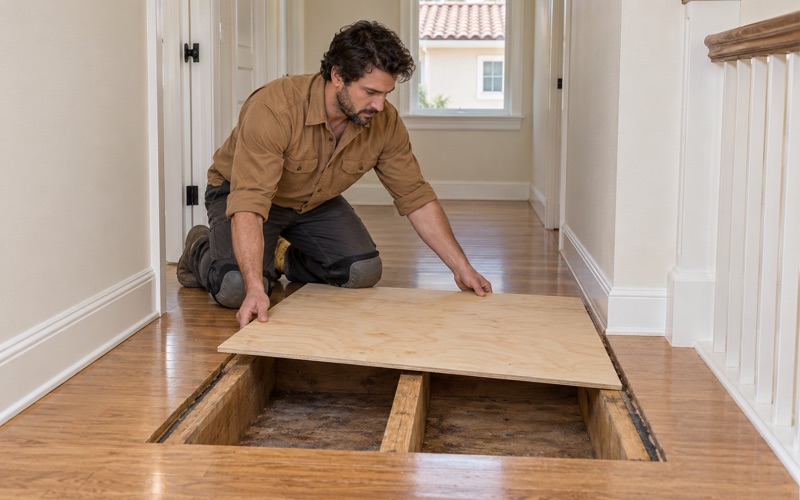
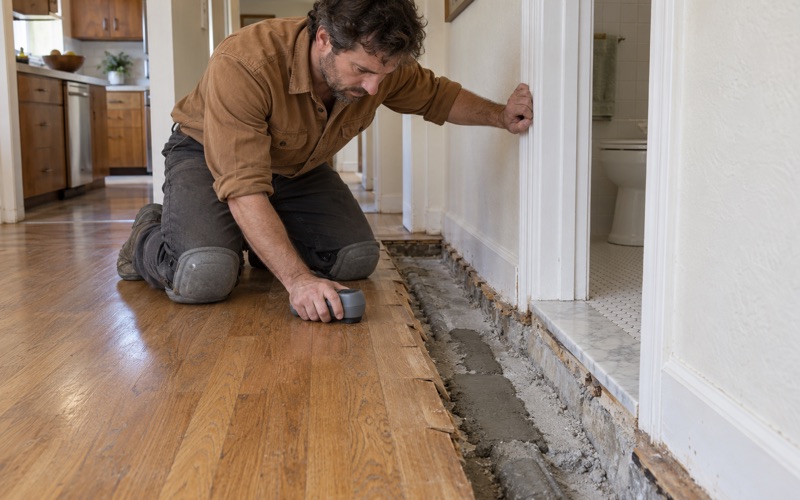
Soft spots near toilets, tubs and exterior doors are traced to the plywood subfloor and floor joists before we price a finish floor. If the cause is a plumbing leak, the plumber repairs or reroutes the line first, and we plan any access opening so it can be closed with a clean board replacement or weave-in repair instead of a visible patch.
Termite damage is the other common cause of a failing board. Drywood termite frass under baseboards or powderpost beetle holes in a board tell us the wood needs treatment or fumigation before it is refinished, and fumigation is itself one of the repairs the city program lists. We note that in the scope so the order of work is clear.
Measure moisture and write it down
Before any material is ordered, we take wood moisture meter readings in the existing boards and in the new stock, and we test any concrete in the assembly with an ASTM F2170 in-situ relative humidity test or a calcium chloride moisture test. New flooring is given time for acclimation until its moisture content is close to the house it is going into. Every reading goes on paper.
An estimate you can hand to someone else
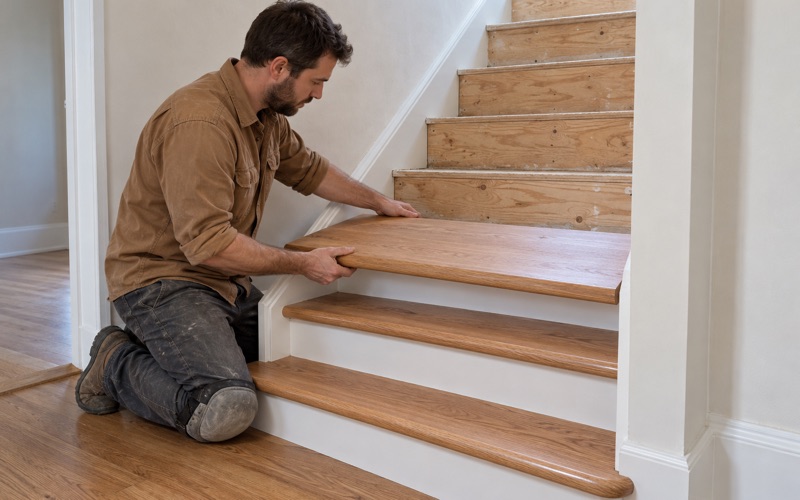
Our estimates are itemized line by line: demolition, adhesive removal, subfloor repair, material by species and Janka hardness rating, installation method, sanding grit sequence, finish, and trim. Stairs are priced per stair tread and stair riser, with stair nosing listed separately, rather than being folded into a square-foot figure. A reviewer at a program office, a family member or a second contractor can read it without calling us to translate.
Planning Floor Work in La Habra
Once the scope is written, the choices narrow quickly. The main decision is usually repair and refinish versus replace, and it depends on the wear layer thickness of what is there, how much of the floor the subfloor repair will disturb, and whether matching boards can still be found.
Refinishing what can be saved
Solid strip flooring and parquet in a postwar house often have enough wood left for a full sand. We restore, patch or lighten old parquet rather than tearing it out by default, and we correct orange oak or blotchy stain with a careful grit sequence and a stain test on a hidden board. Where the finish is only dull, a screen and recoat can be enough.
Finishes are chosen from products legal to apply in the South Coast air basin under SCAQMD Rule 1113, which sets the wood coatings VOC limit at 275 g/L. In practice that usually means a waterborne polyurethane, an oil-modified polyurethane that meets the limit, or a hardwax oil finish, with the sheen level agreed before we start.
Replacing when the floor is past saving
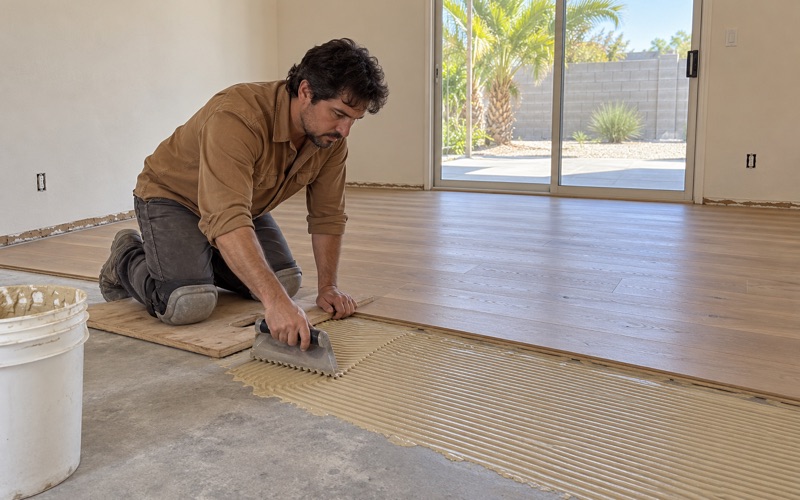
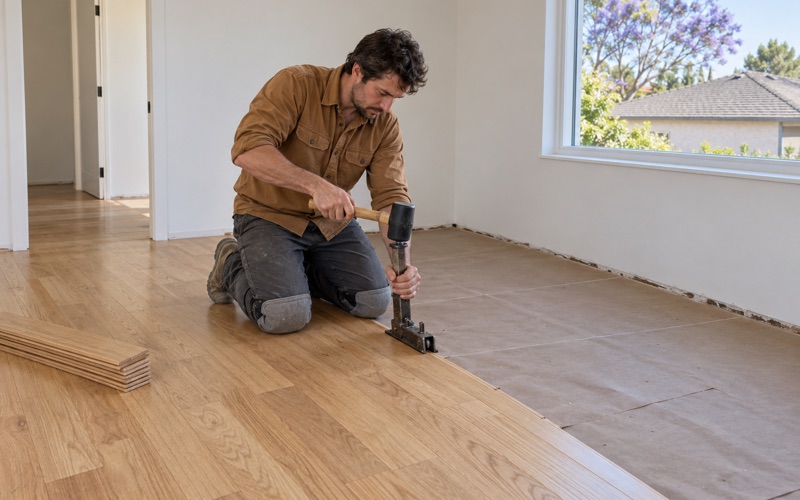
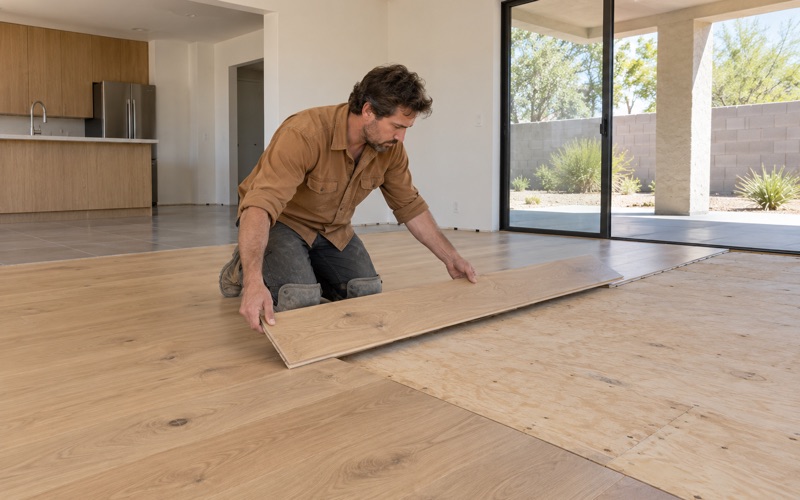
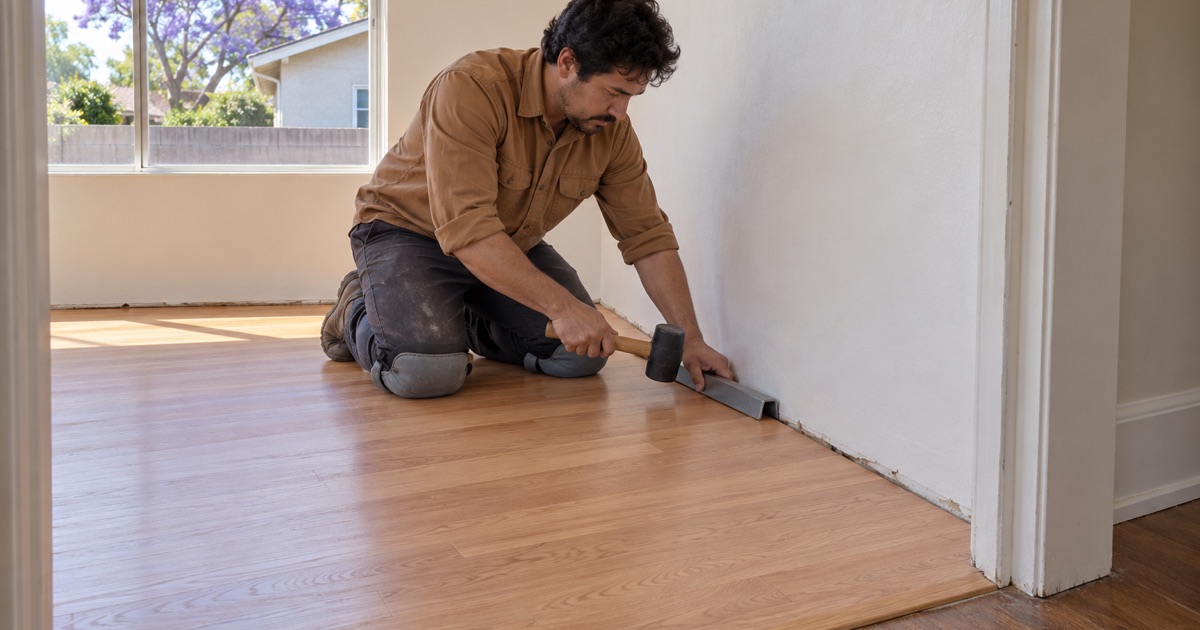
When boards are cupped, crowned or split beyond repair, we replace with site-finished hardwood or prefinished hardwood by nail-down, glue-down or floating installation, following NWFA installation guidelines for expansion gap and fastening. Engineered flooring is compared by its wear layer and engineered core construction, and we confirm composite cores are CARB Phase 2 compliant under TSCA Title VI.
Living in the house during the job
Most La Habra owners we work with stay home while the floor is done, so we hand over a written cure schedule showing when each room can take foot traffic and when furniture can go back. Rooms are sequenced so a kitchen or bathroom is never out of use longer than the work demands.
Who to call at the city
La Habra has its own Building and Safety Division at 110 East La Habra Boulevard, reachable at (562) 383-4116, with permits handled through a Customer Self Service Online Portal. When a floor repair turns into structural or plumbing work, we suggest checking the scope with that division before work begins. Program questions go to the Housing Division instead, at the waitlist number above.
- 20+ Years in Wood Flooring
- Itemized Written Estimates
- Lead-Safe Sanding