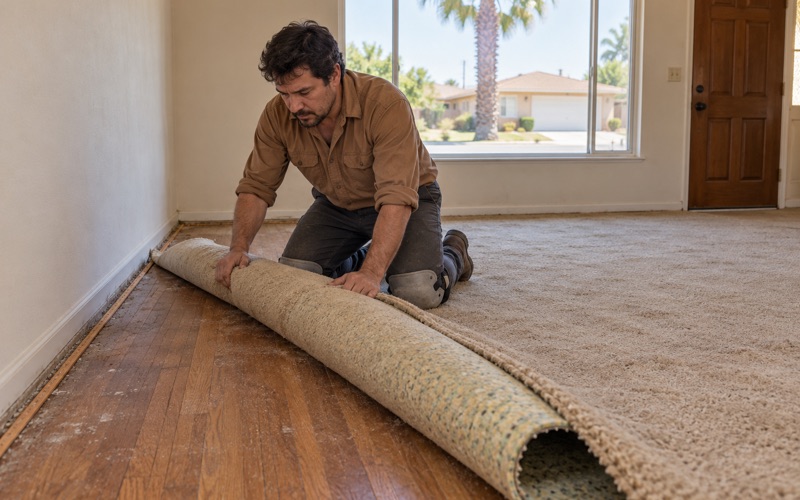
Buena Park Wood Flooring has spent more than 20 years on wood flooring in La Palma and this corner of north Orange County, and this page is written for one particular client: the owner of a rented house or apartment whose tenant pays with a Housing Choice Voucher. Those floors are held to a federal standard, and a failed room puts a deadline on the repair.
Most of what we find in voucher units is not dramatic. It is a traffic lane worn down to bare plywood, a bathroom threshold gone soft around the toilet, or a hallway where someone pulled a damaged section and never replaced it. Each of those reads differently to an inspector, and each one gets priced differently by us.
We also work for renters when a landlord asks them to document a floor, and our estimates are written so either side can hand them to the other. Nothing here promises an inspection result. What follows explains what the standard measures, where a floor actually fails, and how a repair fits inside the time allowed.
Vouchers in La Palma and the Standard Inspectors Use
Who Administers Vouchers Here
The city does not run its own voucher program. La Palma’s adopted 2021-2029 housing element, under Program 1, states that the Orange County Housing Authority administers the Section 8 Voucher Program for several Orange County cities, including La Palma. The same program text says housing subsidized through it must meet the standards of safety and sanitation established by HUD.
That sentence is where a floor comes in. Under the Housing Choice Voucher program the landowner enters into a contract with the housing authority, and the unit is held to HUD’s standard. The city’s stated role is supporting OCHA’s funding efforts and referring apartment complex owners to information about the program, not inspecting units itself.
The Switch to NSPIRE
OCHA’s landlord page states that effective October 1, 2025, it began using HUD’s NSPIRE inspection protocol for the Housing Choice Voucher and Project Based Voucher programs, replacing the older Housing Quality Standards. Owners who passed inspections for years under HQS are now measured against different written criteria, and the floor is one of the standards with its own rules.
NSPIRE’s Floor standard, version 3.0, published August 11, 2023, defines a floor as the lower surface of a room. It lists the parts it treats as components, including carpet, tiles, grout, hardwood flooring, stain, underlayment and padding. That list matters to us because a problem in any one of those layers can be the thing an inspector writes up.
Two Floor Deficiencies That Fail a Unit
The standard names two floor deficiencies that fail a voucher unit. The first is exposed substrate, with the criterion set at 10 percent or more of the floor substrate area exposed in any room. The second is a floor component that is not functionally adequate, meaning it does not let the floor separate levels or be walked on. Both carry a 30-day correction period.
The 10 percent test is applied per room, not per unit. A living room in fine shape does not offset a bedroom where a torn-out section has left a large patch of plywood showing. When we walk a unit ahead of or after an inspection, we measure room by room for that reason, and the written estimate breaks each room out separately.
Looking for wood-flooring closer to La Mirada? See Wood-Flooring Services in La Mirada.
Cupping, Gaps and What Actually Fails
Cupping Alone Is Not the Finding
Hardwood cupping worries landlords more than it should. The Floor standard says that surface abnormalities such as lifting tiles, hardwood cupping and linoleum bubbling may indicate a functional problem, but that the abnormalities alone do not constitute a deficiency. A cupped board is evidence to look behind, not a failure in itself.
Cupping usually tells us moisture is higher on the underside of a board than on its face. We take readings with a wood moisture meter, test any concrete underneath with an ASTM F2170 in-situ relative humidity test, and write every number down. If the source is a slow leak at a supply line, the floor is only a symptom, and refinishing it first just hides the cause.
What Functional Failure Looks Like
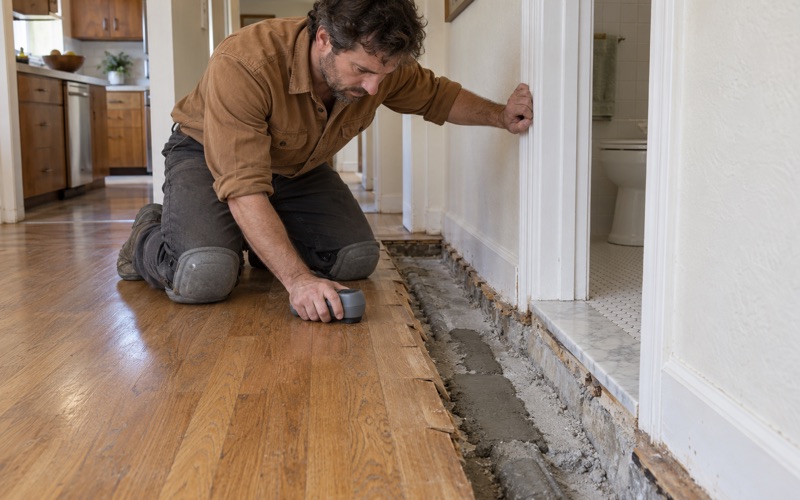
NSPIRE gives wood rot, sloping and deflection as examples of conditions that can make a floor component inadequate. In rental units those tend to cluster at the wet spots: the base of a toilet, the edge of a tub, the entry door where rain gets tracked in. Boards there can look intact while the layer underneath gives under a heel.
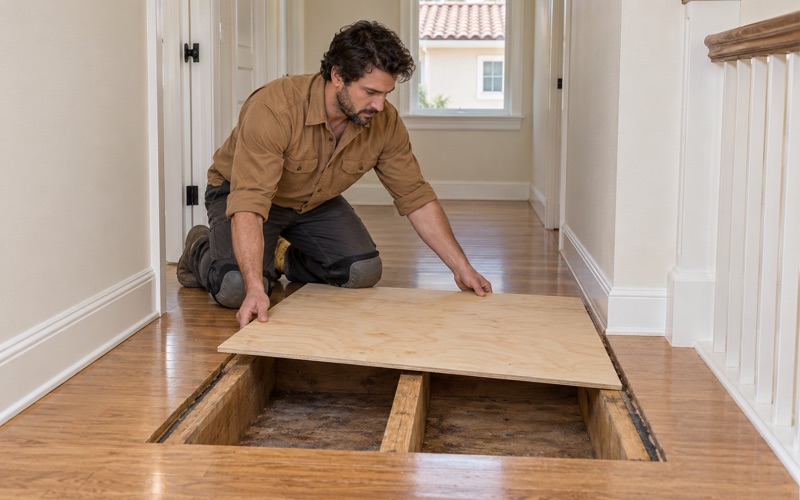
We trace a soft spot down to the subfloor before pricing any finish floor above it. That can mean lifting a threshold or a few boards to see how far the damage runs. A repair that only swaps the visible boards over a rotted panel may feel solid on install day and still flex again once the damaged layer keeps deteriorating.
Gaps, Wear and Bare Concrete
Board gaps from seasonal drying are usually cosmetic. Wear becomes a different matter once it goes through the finish floor entirely. A carpet removed and never replaced, or a laminate section pulled after a leak, can leave the substrate showing across a good part of a room, and that exposure is exactly what the 10 percent test counts.
One detail catches owners who strip a room down to the slab between tenants. NSPIRE accepts polished or painted concrete floors inside a unit, but bare concrete floors are not acceptable in rooms a resident regularly uses. A bedroom left at raw concrete while a new floor is being chosen is a finding waiting to happen.
Fixing a Floor Inside the Correction Window
Scoping the Repair in Writing
Thirty days goes quickly once materials and a tenant’s schedule are involved. Our first visit produces an itemized written estimate naming each room, the deficiency we believe it addresses, the square footage and the material. Owners can send it to a property manager or keep it with the inspection notice, and tenants can see exactly which rooms will be disturbed.
We keep the scope to what the notice and the floor actually need. If an inspector cited one bedroom, we do not quote the whole unit by default. Where a wider problem shows up, such as moisture readings that point toward a leak, we write it as its own line so the owner can decide on it without holding up the cited repair.
Matching, Patching or Replacing
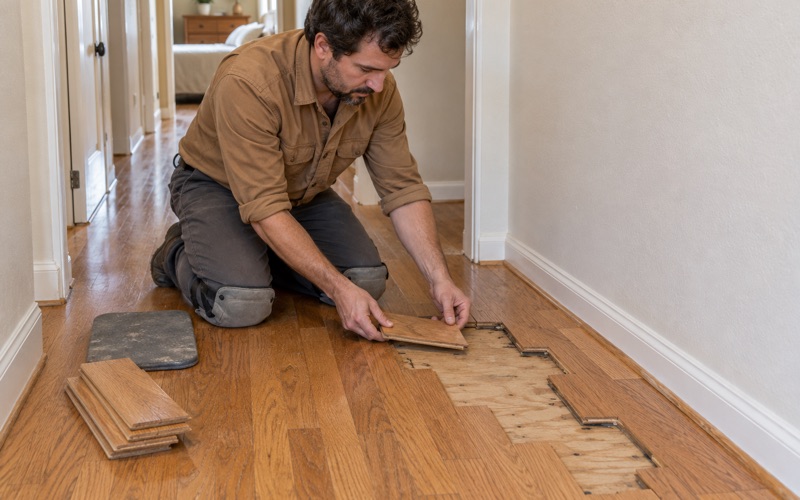
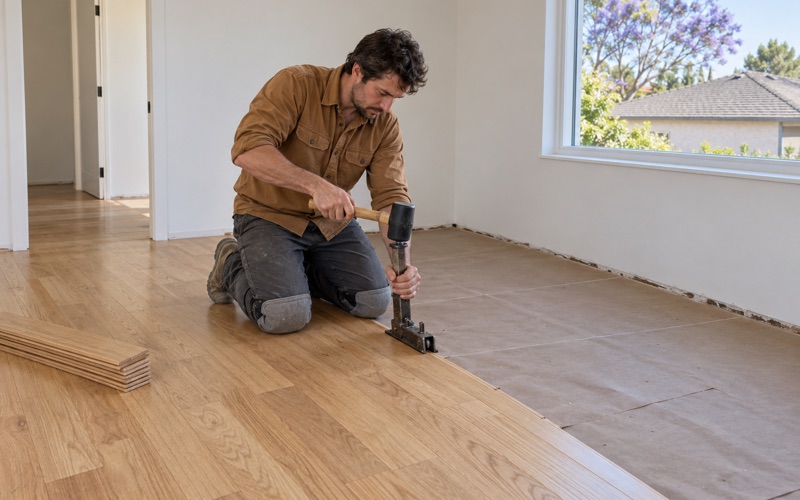
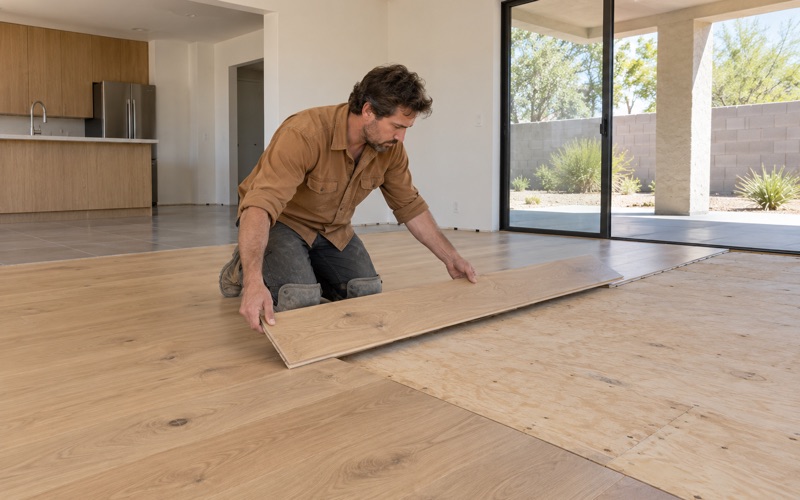
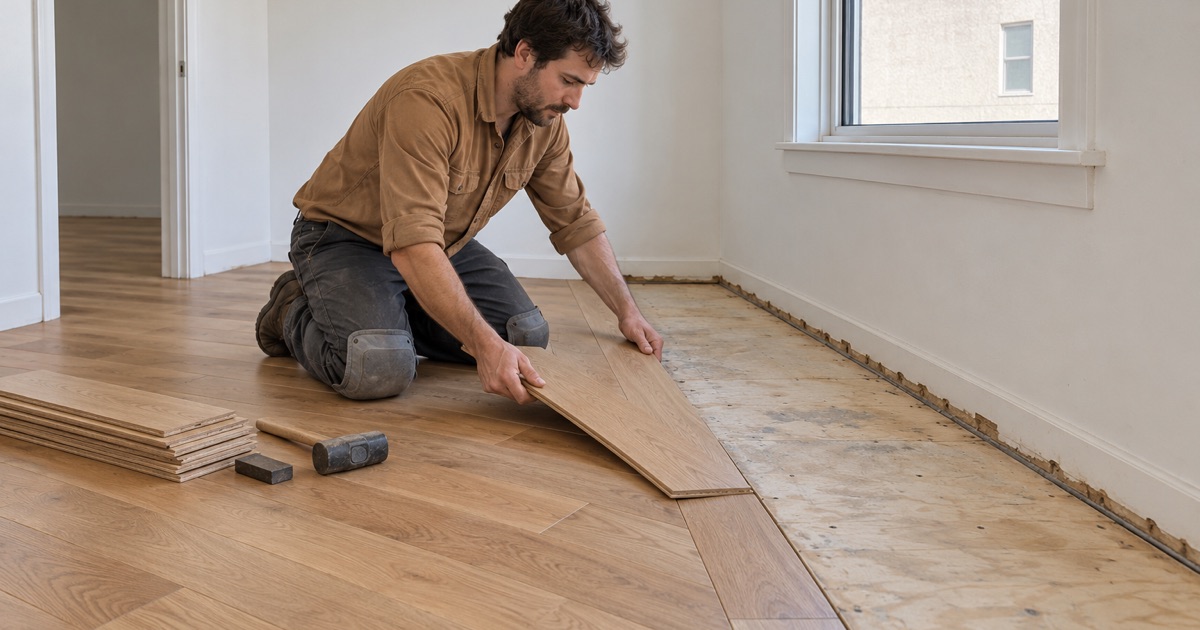
Exposed substrate from a missing section is usually a patch or a weave-in repair, with new boards laced into the existing floor so the joints stagger instead of forming a straight seam. With prefinished product we look for a matching species, width and wear layer first. When nothing matches, running new flooring to the next doorway or reducer strip often looks cleaner than an obvious patch.
New boards need time to acclimate before installation, and we plan that into the schedule rather than skipping it to beat the deadline. Following NWFA installation guidelines on moisture content and acclimation keeps a rushed repair from cupping or gapping a season later, which would mean paying for the same room twice.
Working Around an Occupied Unit
Most voucher repairs happen with the household still living in the unit. We give the tenant a written cure schedule stating when each room can be walked on and when furniture can go back. Finishes come from products that meet the 275 g/L limit for wood coatings under SCAQMD Rule 1113, and waterborne polyurethane is our usual choice when a family stays home through the work.
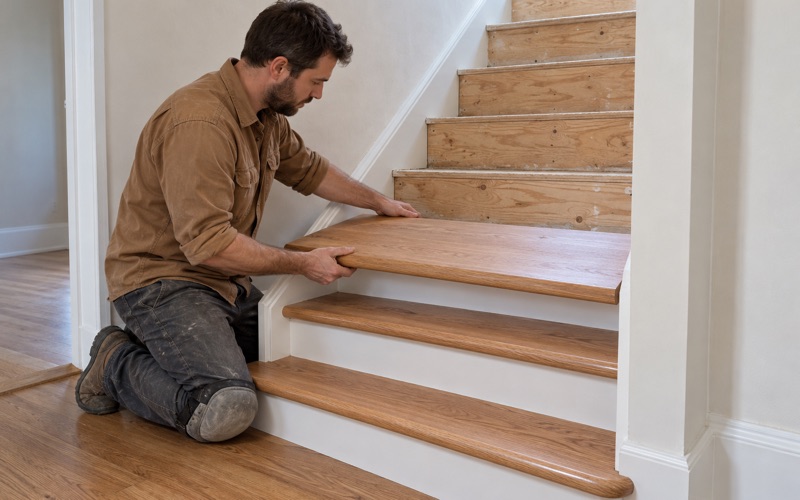
Stairs in townhouse-style units are priced per tread and riser rather than folded into a square-foot figure, so a cited stair nosing does not inflate the whole estimate. When water caused the failure, we rebuild after the area has dried and keep photos and moisture readings that an insurance adjuster can review alongside the owner’s claim.
Floors in La Palma’s Apartments and Rented Houses
Who Rents Here
Renters are not a small slice of this city. Of 5,118 occupied units, 1,660 households, or 32.4 percent, rent their homes. Their buildings vary widely: 553 renter households live in buildings of fifty or more units, while 304 rent detached houses. The first group usually deals with a management office, and the second often deals directly with a single owner.
Renter turnover here is also fairly recent, with 69.0 percent of La Palma renter households moving in during 2010 or later. A change of tenant is often when a pulled carpet or a half-finished patch gets left for later, and an owner who handles the floor during the vacancy avoids handling it under a correction deadline.
An Older Housing Stock
The buildings themselves come mostly from one period: 75.6 percent of La Palma’s housing units were built from 1960 to 1979. Floors in homes of that age have usually been covered, re-covered and patched more than once, so we find out what sits under the current surface before quoting a replacement for it.
Age also changes how we work. Homes built before 1978 get lead-safe work practices under the EPA Renovation, Repair and Painting rule, including containment and cleanup around the work area. Older layers of 9x9 floor tile and black mastic under a finish floor are treated as a possible asbestos question and tested before anyone sands or scrapes them.
Where the City Fits
Construction permits and inspections go through the City of La Palma’s Community Development Department, Building and Safety Division, at 7822 Walker Street, with permits issued through the city’s OpenGov portal. That office is separate from the voucher inspection, which belongs to OCHA. We tell owners which office a given question belongs to rather than guessing on their behalf.
The housing element describes most of La Palma’s housing stock as remaining in good condition, with very few substandard units. Keeping a rental in that group comes down to fixing the room that failed, documenting what was done, and leaving a floor sound enough for whoever lives on it next.
- 20+ Years in Wood Flooring
- Itemized Written Estimates
- Lead-Safe Sanding