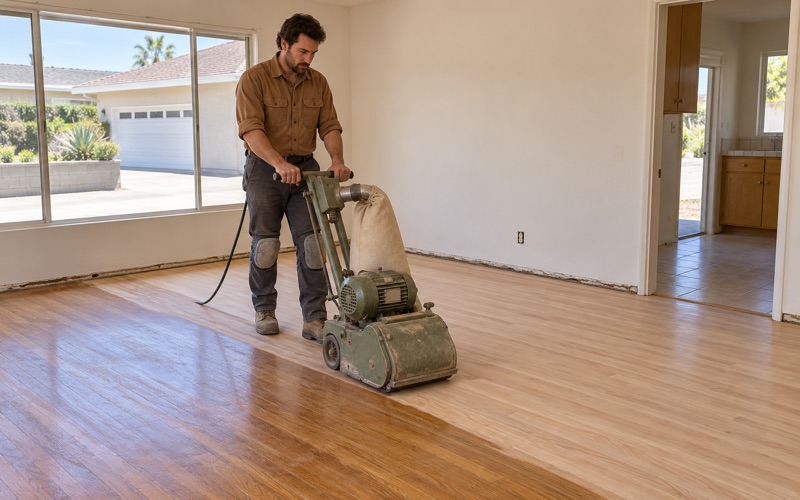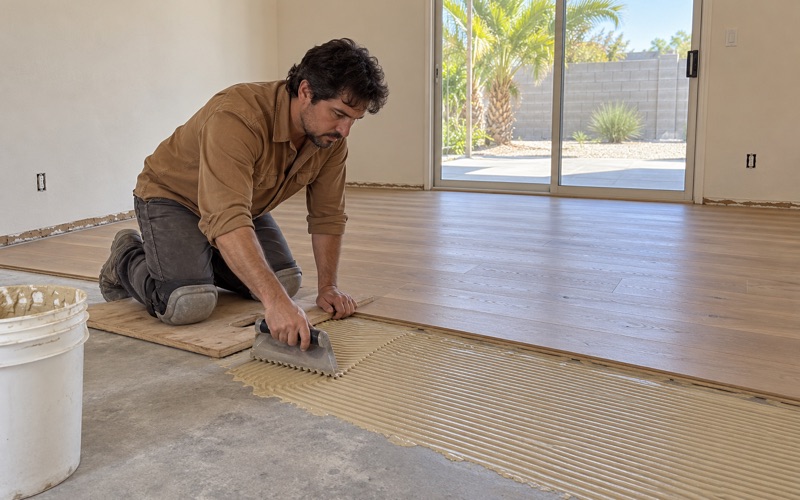
Buena Park Wood Flooring has handled wood flooring in Santa Fe Springs for owners and landlords over 20+ years of sanding, repairing and installing floors, most of them boards that were laid decades before we arrived. We measure moisture in the wood and in whatever sits beneath it before a single box of material is ordered, and we write those readings down so the next person to inspect the floor sees exactly what we saw.
Much of the work here is ordinary: refinishing worn oak, quieting squeaks, replacing boards that cupped after a leak under the sink. This page also covers something less ordinary, which is what the city’s own hazard planning says about serious water, and how an owner protects a wood floor and recovers it if water ever does come in.
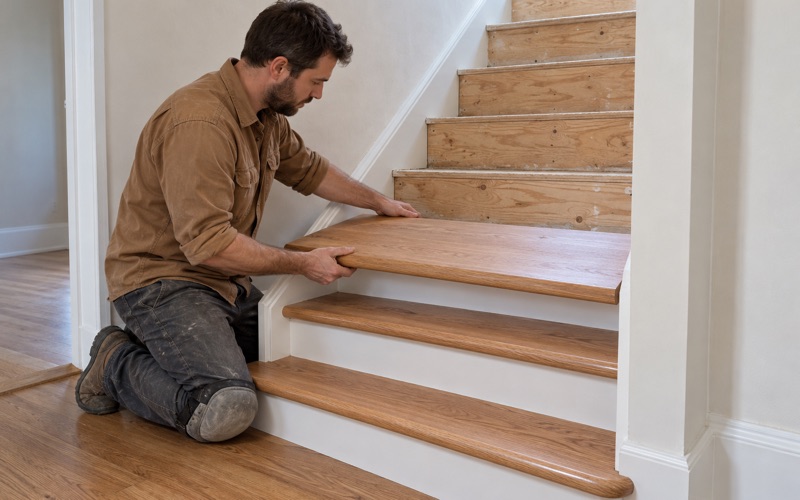
Every estimate we hand over is itemized, so a homeowner, a landlord, a tenant or an insurance adjuster can read line by line what the floor needs and what each part costs. Stairs are priced per tread and riser rather than buried inside a square-foot number.
A Flood Line at Norwalk Boulevard in the City’s Plans
Whittier Narrows Dam in the Hazard Planning
The Santa Fe Springs General Plan and the city’s Natural Hazards Mitigation Plan, as quoted in a 2021 environmental study for a housing project on Lakeland Road, name the Whittier Narrows Dam as the greatest potential source of dam-failure flooding. The dam sits about five miles northwest of the city.
The same study quotes the city’s Multi-Hazard Functional Plan stating that there is a low risk the city will experience flooding due to dam failure. We take that framing at its word. This is a mapped planning scenario, not a forecast, and nothing in the city’s documents suggests the dam is expected to fail.
The Western Portion of the City
If a failure did happen, the plan says the western portion of the city located to the west of Norwalk Boulevard would see flooding about one hour afterward. Maximum depths could reach as high as five feet, gradually declining to four feet at the southern end of the affected area.
Santa Fe Springs is one of the Gateway Cities of southeast Los Angeles County, with 19,219 residents at the 2020 census. Its housing element says residential neighborhoods have historically been concentrated in the western portion of the city, with small pockets along the eastern boundary. That is a statement about where homes were built, made in a separate document, and it does not place any particular house inside the flood scenario.
Why a Floor Contractor Reads a Hazard Plan
We are not emergency planners, and we don’t advise anyone on insurance. We mention the scenario because it shapes one practical question we help owners answer: how much effort to put into making a floor recoverable, and how to document its condition so any future repair starts from a known baseline.
Looking for wood-flooring closer to Garden Grove? See Garden Grove Wood-Flooring.
Low Risk, High Stakes for 1950s Wood Floors
The city incorporated in 1957, and the housing element says the majority of its residential growth happened during the 1950s. Census figures agree: 2,682 of the city’s 5,927 housing units, or 45.3 percent, were built between 1950 and 1959, and 84.2 percent of owner households live in detached houses.
What a Seventy-Year-Old Floor Can Take
A wood floor from that decade has often been sanded more than once. Each sanding removes wood above the tongue, and a thin floor tolerates water worse than a fresh one, because a board that cups can no longer be sanded flat without exposing nails, cleats or tongues.
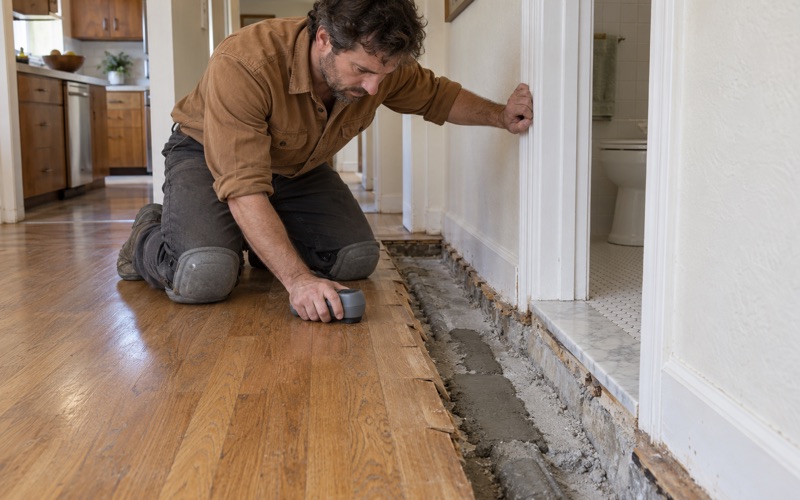
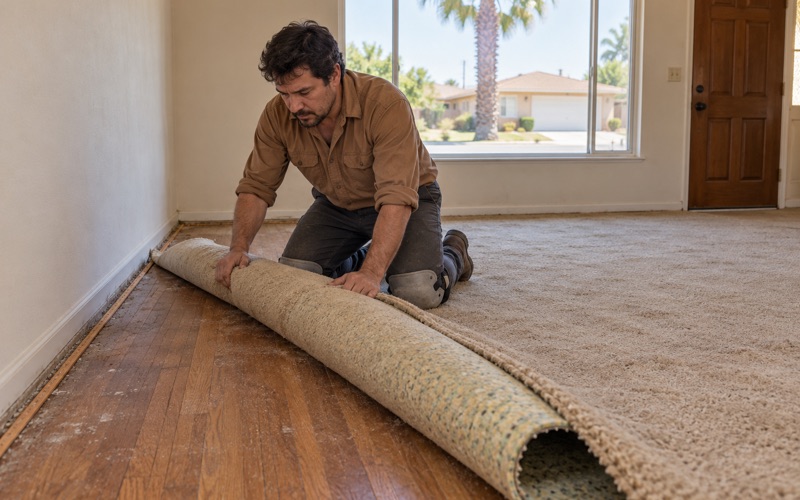
So we check how much wood remains before we talk about anything else. Where carpet has covered oak strip for years, we lift a corner, look at the tack strip and staple holes, and assess the boards one at a time before anyone quotes a replacement.
A Baseline Before Anything Happens
Low risk is not no risk, and everyday water is far more common than any dam scenario: a supply line under a sink, a failed toilet seal, an aging water heater. When a job wraps up, we can record moisture content room by room with a wood moisture meter. That record turns a later argument about whether a floor was already cupped into a comparison of two numbers.
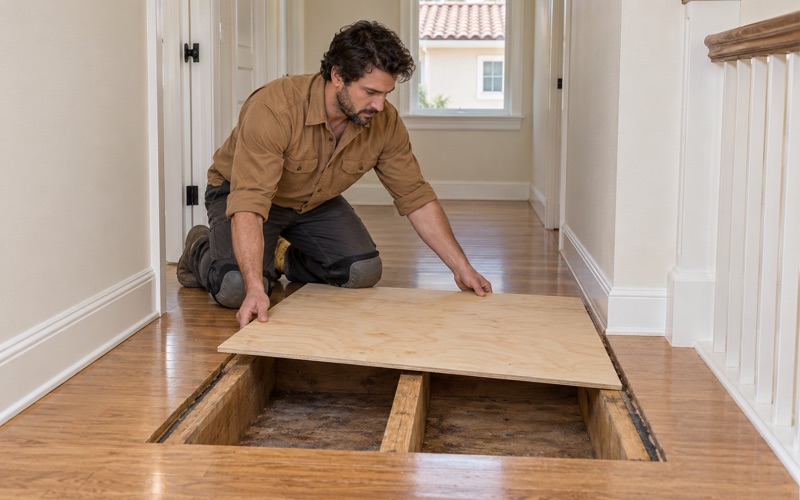
Soft spots near toilets, tubs and doors are traced down to the subfloor before we price a finish floor. In an older house, a soft spot often marks a slow leak that started long before anyone noticed, and laying new boards over it only hides the damage.
Lead and Adhesive Caution on Older Houses
Nearly every home from the 1950s is pre-1978 housing, so we follow lead-safe work practices under the EPA Renovation, Repair and Painting rule whenever sanding or demolition could disturb old paint on trim, thresholds or stair parts.
Old parquet and tile get their own caution. The adhesive underneath, including black mastic, is treated as a possible asbestos question before anyone scrapes it, and parquet is restored, patched or lightened rather than torn out by default.
When Water Reaches a Wood Floor
Whether the source is a burst pipe or something far rarer, wood floors respond the same way. Boards absorb water through their edges and undersides, swell against each other and cup. Left wet long enough, they can buckle off the subfloor, and engineered flooring can suffer veneer delamination.
The First Hours and Days
Once the source is stopped and the house is safe to enter, getting standing water out and air moving matters more than anything else. Pulling up rugs, moving wet furniture and removing baseboards and shoe molding lets trapped moisture escape along the wall edges instead of wicking deeper.
Don’t sand a cupped floor while it is still wet. A floor sanded flat before it dries will crown once it does, and the wood removed can’t be put back. We take readings over days, not hours, and compare them against a dry reference area elsewhere in the house.
Saving Versus Replacing Wet Wood
Solid oak strip that got wet for a short time and dried under control often settles back close to flat. What remains is usually light cupping, some board gaps and damaged finish, which sanding and a new finish can address if enough wood is left above the tongue.
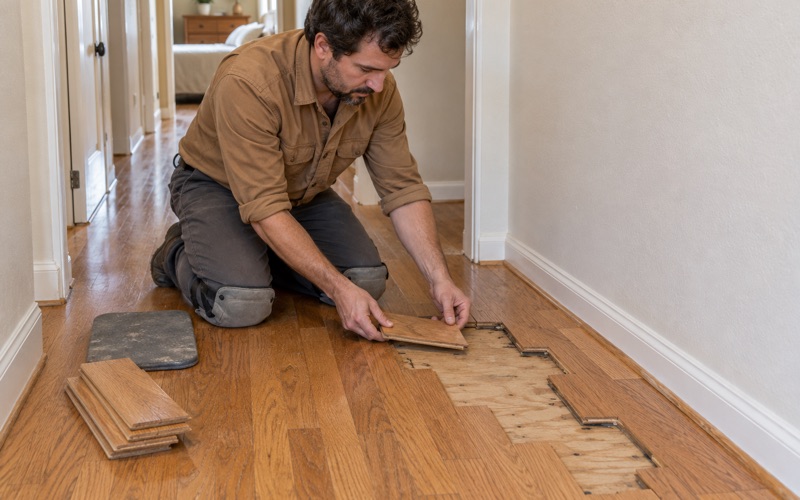
Replacement becomes the answer when boards have pulled off their fasteners, when the subfloor itself is soft or decayed, when an engineered veneer has separated from its core, or when water sat long enough to stain deep into the grain. Where only part of a room is lost, a weave-in repair ties new boards into the old ones so the floor reads as one surface after refinishing.
Documentation an Adjuster Can Use
After drying, we rebuild water-damaged floors with photos and moisture readings recorded at each stage. The estimate lists removal, subfloor repair, new material, sanding, finish and trim as separate lines, the format an adjuster, a landlord or a tenant can follow without calling us to translate it.
Planning Floor Work in Santa Fe Springs
Acclimation and Moisture Before Installation
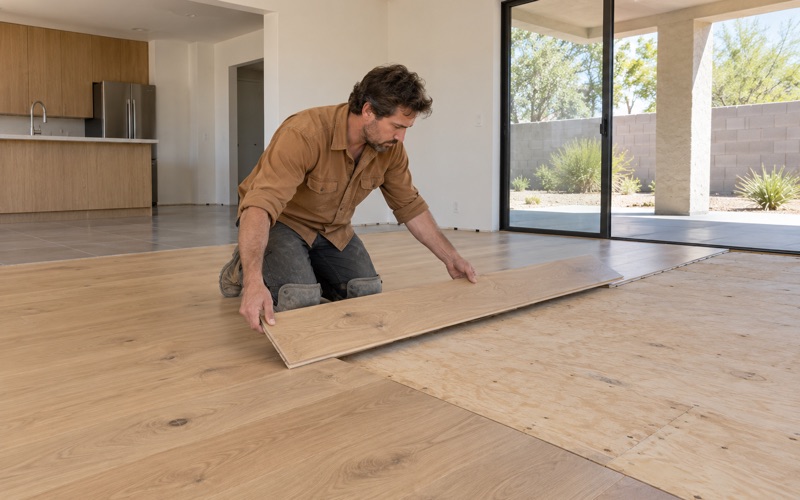
New wood goes into a house only after its moisture content is close to that of the rooms it will live in. We measure both the flooring and the subfloor, follow the NWFA installation guidelines for acclimation, and write the numbers on the job record.
Where new flooring goes over concrete, we test the concrete as well, using an ASTM F2170 in-situ relative humidity test or a calcium chloride moisture test, depending on what the product’s maker requires. A house that has had water in it at any point deserves extra care here, since a subfloor that looks dry can still hold moisture.
Finishes, Air Rules and Cure Time
The city falls under the South Coast Air Quality Management District, and every finish we apply is chosen from products legal in that basin under SCAQMD Rule 1113 and its 275 g/L VOC limit for wood coatings. Waterborne polyurethane, oil-modified polyurethane and hardwax oil finishes all have compliant options, each with its own look and upkeep.
Many households stay home through the job. We hand over a written cure schedule showing when each room can take socks, then shoes, then furniture and rugs, so a family can plan meals, pets and sleep around the work rather than guessing.
Choosing Material With Water in Mind
For a room near a water heater, a laundry area or an exterior door, a finish that can be spot-repaired is worth considering. A higher Janka hardness rating helps with dents, but where water is concerned, the installation method and how quickly someone notices a leak matter more than the species.
Engineered flooring with a thicker wear layer can be sanded more than once, which keeps a future refinish possible after minor water damage. Products with a thin veneer may have to be replaced instead, a trade-off we explain before anything is ordered.
What Stays With the House
Each job ends with an itemized record: what was installed or refinished, the finish used, the moisture readings and the date. For an owner of a 1950s house anywhere in the city, that record is the simplest thing to have on hand if a floor ever has to be recovered.
- 20+ Years in Wood Flooring
- Itemized Written Estimates
- Lead-Safe Sanding