Buena Park Wood Flooring handles wood-flooring in Stanton with more than 20 years behind us, and in this city a good share of our jobs start with a document rather than a pry bar. When the home sits in a mobile home park, the rental agreement and the park’s rules shape what we can do and when we can do it.
So before we quote a single board, we ask to see those papers with you. We want to know what the park expects from a homeowner planning floor work, whether anything has to be approved in writing first, and how the park handles contractor access. Settling that early is what keeps a floor job from stalling halfway through.
The same care carries into the work itself. We measure moisture in the wood and in any concrete before material is ordered, write the readings down, and give you an itemized estimate you can hand to park management, a landlord or a family member who shares the decision.
Stanton’s Park Homes and the State’s Alteration Notice
How Many Stanton Households This Touches
Park homes are not a side note in Stanton. The 2024 American Community Survey counts 1,352 owner households living in a mobile home, which is 22.1 percent of all the city’s owners. Another 437 renter households live in mobile homes as well, and mobile homes make up 14.2 percent of Stanton’s 13,269 housing units.
Those numbers are context, not a sales pitch. They explain why so many of the floor calls we take from this city of 37,962 people involve a park home, and why the first conversation often covers the rental agreement before it covers wood species, plank width or finish sheen.
What Item 8 of the Notice Says
California’s Mobilehome Residency Law requires every park rental agreement to be in writing and to carry a notice headed ‘Important Notice to All Manufactured Home/Mobilehome Owners.’ Item 8 of that notice, in Civil Code section 798.15, says a homeowner may not make improvements or alterations to the space or home without following the park’s rules and regulations and all applicable local ordinances and state laws.
The same item says compliance may include obtaining a permit to construct and, if the park rules or the rental agreement require it, prior written approval of management. It closes with a plain warning: failure to comply could be grounds for eviction from the park. That wording reflects AB 2399, which amended the section effective January 1, 2025.
What the Notice Leaves to Your Own Paperwork
The notice sets the framework, but it does not say whether new flooring counts as an alteration in any particular park, and we will not guess on your behalf. The state’s title 25 regulations list work that is not an alteration, including repairs with approved component parts, yet that section does not name floors at all.
In practice, the answer for your home lives in your own rental agreement, your park’s rules and any agency with authority over the work. Those are the documents we read with you before we plan anything else, and we keep our advice to the floor itself.
Looking for wood-flooring closer to Hawaiian Gardens? See Hawaiian Gardens Wood-Flooring.
Checking the Rules Before Floor Work Starts
Reading the Rental Agreement and Park Rules Together
We start with the two documents most park homeowners already have: the rental agreement and the current park rules. We look for any section on improvements, alterations, contractor work hours, parking for work vehicles, and where debris and old flooring may be placed. Park rules vary, so we read yours rather than assuming what another park does.
If the language is unclear, we write down the exact question and suggest you take it to the park office in writing. A short written question tends to get a clearer answer than a hallway conversation, and it leaves a record you can keep with the rest of your home’s paperwork.
Getting Approval in Writing When It Is Required
Where the rules or the agreement call for prior written approval from management, we help you prepare what the office is likely to ask for. That usually means a description of the rooms involved, the flooring material, the removal plan for the old floor, and the expected start and finish dates.
Our itemized estimate is built to double as that description. It lists each room, the material, the removal and disposal steps, and any trim, transitions or stair work, so management can see the scope at a glance. We do not start removal until you tell us the approval, if one is needed, is in hand.
Where the City Points Park Residents
The City of Stanton keeps a Housing Resources page with a section for mobile homes. It links to the 2025 California Mobilehome Residency Law, to HCD’s Mobilehome Assistance Center and to HCD’s mobilehome FAQs, with flyers and brochures in English, Spanish and Vietnamese on residency-law protections.
That page is a sensible first stop if you want to read the law yourself or have a question about your rights as a park resident. We are a flooring company, not a legal advisor, so when a question turns on the law rather than the floor, those resources are where we send you.
Access, Scheduling and the Park Office
Who Can Enter the Home
Access is where park floor jobs differ most from other work we do. Under Civil Code section 798.26, park ownership or management has no right of entry to a mobile home without the prior written consent of the resident, and that consent can be revoked in writing at any time. The exceptions are an emergency or a home the resident has abandoned.
That protection belongs to the resident, and it shapes how we plan. If the park wants to look at the work, the visit happens on the resident’s terms. We coordinate any walk-through with you first rather than arranging it directly with the office.
Planning the Days Around the Park
Once the paperwork is settled, we build the schedule around the park as well as the home. We ask about quiet hours, where our vehicle can park, and whether the office wants notice before a crew arrives. Old flooring leaves in bundles, so we also confirm where it can be staged and how quickly it has to be hauled away.
Inside the home we check the moisture content of the new wood against the existing floor before anything is installed, and we record the readings. Stanton sits in the National Weather Service’s Orange County Inland forecast zone, but acclimating material to the home’s own conditions matters more than any regional rule of thumb.
Finishes, Dust and a Written Cure Schedule
Park homes are compact, and most households stay put during the work. That is why every job comes with a written cure schedule showing when each room can be walked on in socks, when furniture can go back, and when rugs are safe. For a site-finished floor, we choose coatings legal to apply in the South Coast air basin under the 275 g/L wood coatings limit in SCAQMD Rule 1113.
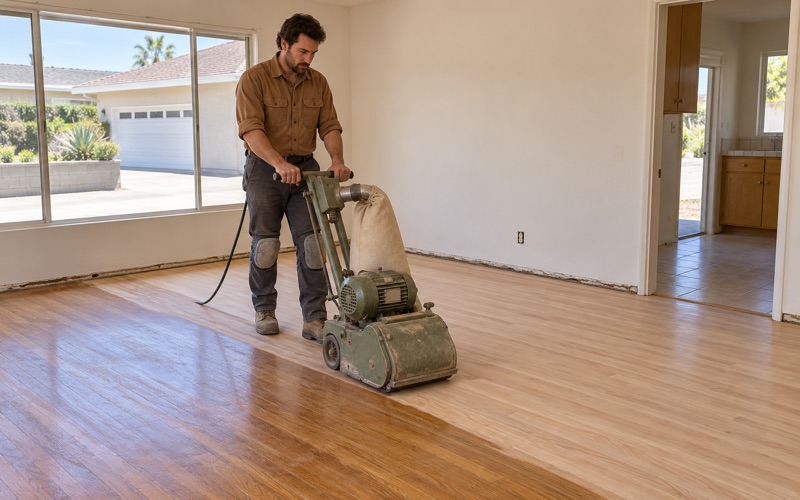
Prefinished hardwood or engineered planks can shorten the time a room is out of use, and we will talk through that trade-off with you. Whatever the choice, we use a dustless sanding system where sanding is needed and keep the work zone sealed off from the rooms you are living in.
When the Park Home Is Rented Out
Keeping the Owner and the Tenant in the Loop
Some Stanton park homes are owned by one household and lived in by another. The notice in the park rental agreement is addressed to the homeowner, while the tenant is the one living with the work, so we make sure both are part of the plan before a start date is set.
We give the owner an itemized estimate to keep with their records, and we give the tenant a plain schedule of which rooms are affected and for how long. We arrange access directly with the tenant and confirm each work day in writing, so nobody is surprised by a crew at the door.
Older Homes and Lead-Safe Practices
Stanton’s housing stock leans older: 65.2 percent of the city’s units were built before 1980, and the 1970s were the busiest building decade at 28.6 percent. When a home was built before 1978, we follow lead-safe work practices under the EPA Renovation, Repair and Painting rule wherever painted trim, baseboards or door casings could be disturbed.
Old adhesive under tile or sheet flooring can raise its own question. If a layer under the existing floor could contain asbestos, we treat that as something to test before removal rather than something to scrape up and find out about later.
What We Hand Over at the End
When the floor is done, you get paperwork to match the work: the moisture readings, the product and finish used, the cure schedule, and the final itemized invoice. For a park home, that file sits beside the rental agreement and any approval you received, so the next person who asks what was done has an answer.
If you are planning floor work in a Stanton park home, start by pulling out your rental agreement and park rules. We will read them with you, help you put any questions to the office in writing, and build the rest of the job around what those papers say.
- 20+ Years in Wood Flooring
- Itemized Written Estimates
- Lead-Safe Sanding