
Buena Park Wood Flooring has handled water damaged hardwood floor repair in Buena Park, CA for 20+ years, serving surrounding cities including La Palma, La Mirada, Cypress, Cerritos, Stanton. We rebuild hardwood floors after slab leaks, burst supply lines, dishwasher and water heater leaks, once the water has been stopped and the floor has dried.
Water damage is a sequence of trades, and the floor comes last. A plumber stops the leak, a mitigation company dries the house, and then we take our own moisture readings, decide which boards can be saved and which cannot, and rebuild the floor so the repair blends in.
Every step is documented with photos and written moisture readings. That record is what makes an insurance claim move smoothly, and it is what protects you if the floor is ever questioned when the house is sold.
Where the Water Comes From
Slab Leaks Under Concrete Floors
A house built on a concrete slab often has its water lines running through or under the concrete. When one of those lines develops a pinhole leak, water rises through the slab into the flooring above, often showing first as a warm spot in the floor, a damp baseboard, or boards that start to cup for no visible reason.
Leak detection and the repair belong to a plumber, who may fix the line through an opening in the slab, reroute it through the walls or attic, or repipe the house. We plan the floor around whichever repair is chosen.
Dishwasher, Water Heater and Supply Line Leaks
A failed dishwasher hose, a leaking water heater, or a toilet or sink supply line can soak a floor for days or weeks before anyone notices. Water spreads under the boards farther than it shows on the surface, so the damaged area is usually larger than the stain. We map the full extent of the wet area with a wood moisture meter before recommending anything, rather than replacing only the boards that look bad.
Leaks Around Toilets, Tubs and Doors
Slow leaks around toilets, tubs and exterior doors damage the subfloor as well as the finish floor. We check the subfloor wherever we find soft spots, and repair it before new hardwood goes down over it.
These leaks rarely come with a single dramatic event, so they are easy to miss until the floor is already soft or stained. Dark edges on the boards around a toilet or a tub are often the first visible sign, and worth a moisture reading even when the floor still feels solid.
Drying Comes Before Rebuilding
Why Wet Wood Has to Dry First
Wood swells as it absorbs water, and boards pressing against each other cup, crown or buckle off the subfloor. If the floor is sanded flat or new boards are installed while the wood is still wet, the floor shrinks as it dries and ends up crowned, gapped or loose. That is why the moisture content of the floor, not the date on the calendar, decides when repair work can start.
Moisture Readings Taken and Recorded
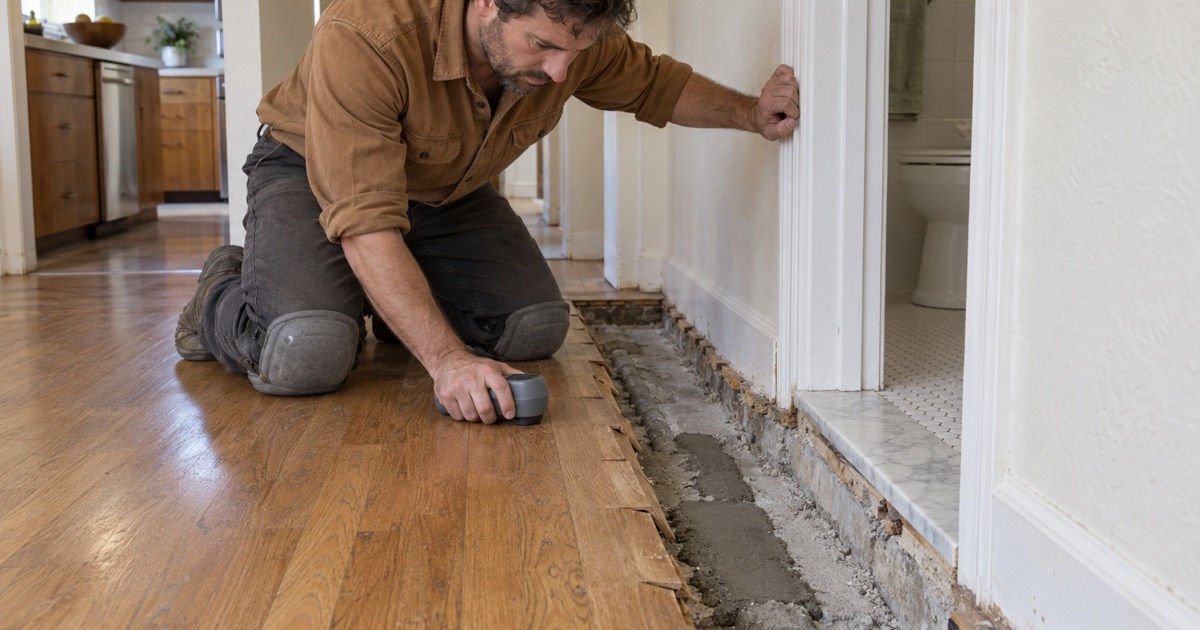
We take readings in the damaged boards, in unaffected boards elsewhere in the house for comparison, and in the subfloor or slab underneath. On concrete, we test the slab directly, since a slab can hold water long after the wood above it has dried. The readings are written down with the date and location, and they go into the estimate and the claim file.
We repeat the readings on the day work begins. If the numbers have moved since the estimate, we say so and adjust the schedule, rather than installing over a floor that has taken on moisture again.
Cupped Floors That Flatten on Their Own
Mildly cupped hardwood often flattens as it dries, and a floor that looked ruined a week after the leak may need only a refinish once it has settled. We would rather wait and save boards than replace a floor that would have recovered.
Some cupping never fully relaxes, especially in wide boards or where the water sat for a long time. Once the floor is dry and stable, any remaining cup can be sanded flat as part of the refinish, which is safe then in a way it is not while the wood is still wet.
Rebuilding the Floor
Planning the Slab-Leak Access Opening
When the plumber has to open the slab to reach the leaking line, the flooring above has to come up first. We work with the plumber before any boards are cut so the opening is only as large as it needs to be, and so the boards removed can be saved for reuse where possible. After the line is repaired and the concrete patch has cured and dried, we lay the floor back over it.
Weaving In New Boards or Replacing the Room
When damage is limited to part of a room, we remove the damaged boards and weave in matching ones with staggered joints so the repair does not show as a rectangle. The area is then sanded and finished to blend with the rest of the floor. When damage is widespread, or the floor cannot be matched, replacing the flooring in the whole room is often the better answer, and the estimate explains why.
Engineered Floors After Water Damage
Engineered hardwood reacts to water differently from solid. Its wear layer can separate from the core, and fiberboard cores can swell permanently. Delaminated planks have to be replaced, and we look for matching stock, or spare boxes left from the original installation, before recommending a larger replacement.
Refinishing After the Repair
Once the new boards are in and the floor is dry and flat, the repaired area is sanded and finished. Where only a few boards were replaced, we can sometimes finish the patch alone, but a room that went through a leak usually has water marks, cupping lines and finish damage beyond the replaced boards.
Refinishing the whole room is then the way to a floor that looks like one surface. We choose a finish that meets South Coast air rules and leave you a written schedule for when each room can be used again.
Insurance Claims and Documentation
Photos and Readings an Adjuster Can Use
We photograph the damage before anything is removed, record moisture readings with their locations, and write an itemized estimate that lists every board, every square foot and every step. An adjuster can follow it line by line.
When more damage is found after the floor is opened, we photograph it the same way and send a supplement with the new readings. Keeping the record continuous from the first visit to the last coat of finish is what keeps a claim from stalling over missing evidence.
Matching and Uniform Appearance
California’s claims standards in 10 CCR 2695.9 call for replaced items to be of like kind and quality and to reach a reasonably uniform appearance. For a floor, that can mean refinishing or replacing more than just the damaged boards so the repaired area matches, and our estimate explains why each extra area is included.
Consequential Damage and Labor
The same regulation treats damage caused while reaching a leaking pipe as part of the loss, and states that labor is not subject to physical depreciation. It also requires the insurer to share its scope and estimate, which lets us compare the two estimates and explain any difference in writing.
- 20+ Years in Wood Flooring
- Itemized Written Estimates
- Lead-Safe Sanding