
Buena Park Wood Flooring has installed wide plank hardwood flooring in Buena Park, CA for 20+ years, serving surrounding cities including La Palma, La Mirada, Cypress, Cerritos, Stanton. We lay wide plank floors in white oak, hickory and other species, and we install herringbone and chevron patterns for entries, dining rooms and living spaces where the floor is meant to be noticed.
Wide boards and pattern floors both reward careful planning. A wide plank shows every inch of its grain and every gap that opens between boards, while a herringbone or chevron floor shows every error in its layout, and both depend on getting the moisture, the subfloor and the starting line right before the first board goes down.
We start with the house. Whether your floor sits on a slab or a raised wood subfloor, how the rooms connect, and where you enter and look across the space all decide which product we recommend and where the layout begins.
Wide Plank Floors
Why Engineered Suits Wide Planks
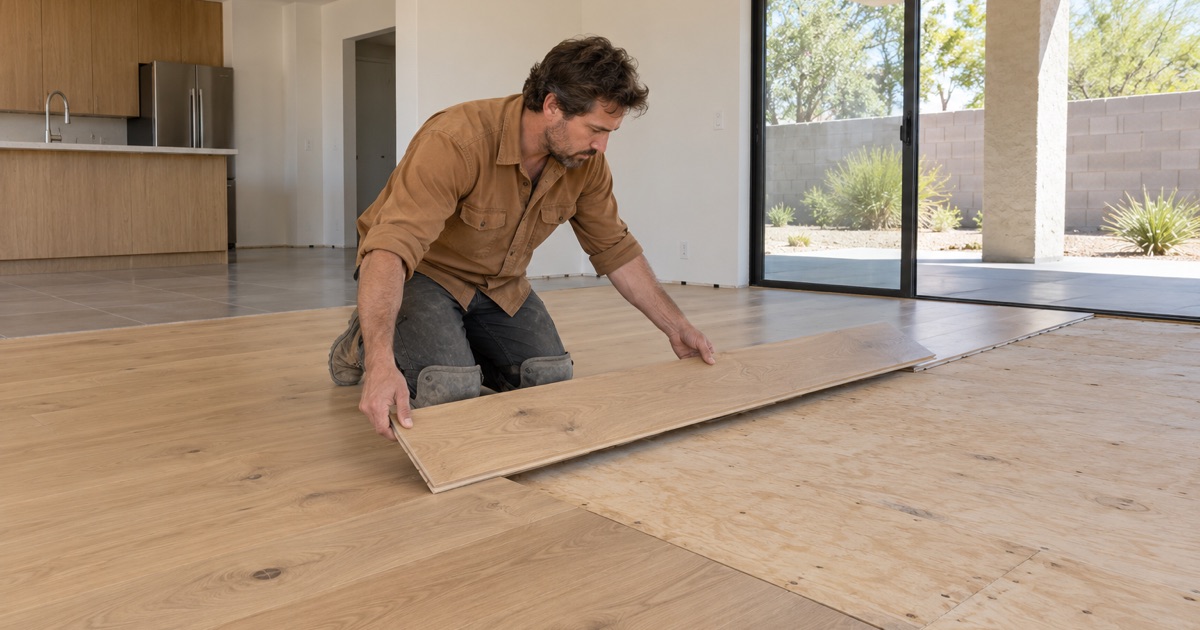
Every board expands and shrinks across its width as moisture changes, so a wide solid board moves more in total than a narrow one, and that movement shows up as seasonal gaps or cupping. Engineered construction, with a real wood wear layer bonded to a cross-laid core, keeps wide planks much flatter, which is why most wide plank floors we install, and nearly all of those on concrete, are engineered.
Choosing Species and Grade
White oak dominates wide plank flooring for its tight grain, cool tone and even response to stain, while hickory brings strong color variation and a higher Janka hardness rating. Grade matters as much as species: a clear grade gives a calm uniform look, while a character grade with knots and color variation hides everyday wear and suits a rustic room.
We bring full-length sample boards rather than small chips, because a character grade looks very different across a whole plank than it does in a square inch. Seeing several boards laid side by side is the best way to judge how busy the finished floor will feel.
Board Lengths and Room Layout
Wide planks look best in long lengths, since short boards break up the floor with frequent end joints. We sort the boards before installing, spreading long and short lengths evenly and keeping end joints well apart from row to row. Planks usually run along the longest wall or toward the main window, which makes a room look longer and calmer.
Herringbone and Chevron Patterns
How the Two Patterns Differ
A herringbone pattern lays rectangular boards at right angles so the end of one meets the side of the next, forming a staggered zigzag. A chevron pattern uses boards cut at an angle on each end so they meet in a clean point, forming a continuous V. Herringbone feels traditional and busy, chevron more linear and modern.
Both patterns can be built from narrow or wider boards, and the board size changes the effect as much as the pattern does. Small boards give a fine, intricate texture suited to an entry or dining room, while longer, wider boards make the pattern bolder and suit a large open living area.
Planning the Layout
A pattern floor lives or dies by where it starts. We find the room’s main sightline, usually from the front door or the main seating area, snap a centerline along it, and build the pattern outward so it reads straight from where people actually look. Borders, a change of direction at doorways, and how the pattern meets the walls are all decided before the first board is set.
Installation and Waste
Pattern floors are usually glue-down installation over a slab, or glued and nailed over a plywood subfloor, since the short boards need a strong bond. Every board is placed individually, and the angled cuts at the walls produce more waste than a straight layout, so we order extra material and price the pattern as its own line.
Subfloor and Moisture Preparation
Flat, Dry and Ready
Wide planks and pattern floors are both unforgiving of an uneven subfloor. We check flatness across the room, grind high spots or fill low ones on a slab, and repair any soft areas on a wood subfloor before starting.
Moisture is tested before any material is ordered, using a wood moisture meter on a wood subfloor or an ASTM F2170 in-situ relative humidity test on concrete. The readings are written down, and they decide which adhesive or vapor retarder the floor needs.
Acclimation and Expansion Space
The flooring is delivered early to acclimate, and we leave an expansion gap at every wall, hidden under baseboard or shoe molding. On a wide plank floor that gap matters more than on narrow strip, because the total movement across the room is greater.
Finishing Wide Plank and Pattern Floors
Site-Finished or Prefinished
Prefinished wide planks arrive ready to use, with slightly beveled edges that hide small height differences. Site-finished floors, including most herringbone and chevron installs, are sanded flat after installation and finished in place, which gives a seamless surface and a free choice of stain.
Sanding a pattern floor takes more care than a straight one, because the grain runs in two directions and any cross-grain scratch shows. We finish the final passes with an orbital sander and check the floor under raking light before any stain or finish goes on.
Finish Choices Under South Coast Rules
Wide planks show off grain, so many owners choose a matte waterborne polyurethane or a hardwax oil finish that keeps the wood looking natural. Every finish we use meets the 275 g/L wood coating limit under SCAQMD Rule 1113, and we leave you a written cure schedule so you know when rugs and furniture can go back.
A low sheen level suits both wide plank and pattern floors, since it hides the fine scratches that a gloss finish would catch across a large, uninterrupted surface. On herringbone in particular, a matte finish lets the pattern itself carry the room rather than the shine.
- 20+ Years in Wood Flooring
- Itemized Written Estimates
- Lead-Safe Sanding